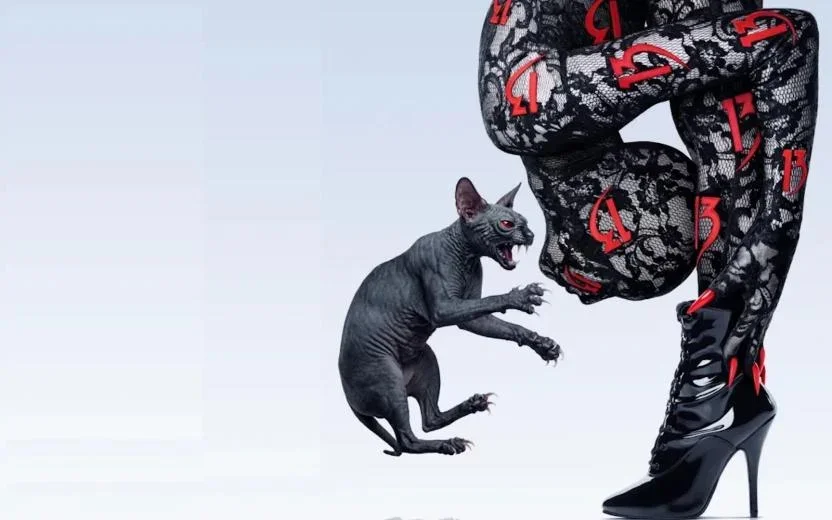
In 2014, American Horror Story was arguably the most exciting thing on television.
By then, the series had already produced three seasons that had become iconic in their own right. Every season reinvented itself. Every episode seemed capable of producing an image you had never seen before.
Most importantly, it trusted the audience.
That is what makes watching American Horror Story: Season 13 such a dispiriting experience.
The problem is not that the show has become too campy, too weird or too excessive. Those were always part of its appeal. The problem is that the writing increasingly seems terrified that the audience will fail to understand what it is seeing.
Characters explain things that should be obvious. Themes are announced rather than dramatized. Characters articulate the significance of events instead of allowing those events to acquire significance on their own. The dialogue repeatedly stops being dialogue and becomes signposting.
At one point Sarah Paulson effectively has to tell us: “This is the portal to Hell.”
Thank you.
The image is apparently no longer permitted to speak for itself.
This is the fundamental difference between the AHS of yesteryear and the AHS of today. The old series could show you something bizarre and let you sit there wondering what the hell you had just witnessed. The new series seems compelled to stand beside the image and explain it.
It is the dramatic equivalent of subtitles for your own imagination.
And once you start noticing it, you cannot stop.
“Drink it.”
“Eat it.”
“These are the rules.”
“This is what is happening.”
“This is what this means.”
The lines arrive with the conspicuousness of dialogue written to make sure nobody misses the point. They do not sound like things human beings would say in those circumstances. They sound like the writers communicating with the audience through the characters.
That is fatal to horror.
Horror depends on uncertainty, implication and the audience's willingness to participate. The imagination is always more frightening when it is allowed to complete the picture itself. A strange look, a pause, an unexplained object, somebody behaving incorrectly: these things create tension because we have to interpret them.
But AHS increasingly interprets itself.
And the irony is that this was once one of television's most confident shows.
In 2014, Freak Show could introduce a bearded woman, a killer clown, a traveling carnival, conjoined twins, a disgraced aristocrat, a murderous strongman and Jessica Lange singing David Bowie — and somehow make the whole thing feel like a coherent universe. It did not require a character to turn toward the camera and explain why any of it was significant.
The show understood something that contemporary television frequently forgets: strangeness is more powerful when it is treated as reality rather than commentary.
The characters were characters.
Elsa Mars had ambitions, vanity, cruelty and longing. Jimmy Darling was not a thematic statement about difference; he was a young man trying to construct a life in a world that had given him almost no reason to believe one was possible. Dandy was not simply “a commentary on privilege.” He was a spoiled, terrifying human being whose narcissism gradually became monstrous.
Even when the writing was melodramatic, it was melodrama with personalities attached to it.
That is increasingly absent.
The characters in the newer AHS can feel like carefully assembled delivery mechanisms for concepts. They enter scenes carrying a piece of mythology, a thematic statement or an attitude, deliver it, and leave. They have information. They have positions. They have dialogue.
What they increasingly lack is interiority.
You can feel the difference in the way the old characters reacted to horror. They were frightened because something frightening was happening to them.
The newer characters sometimes seem to understand that they are in a horror story and are waiting for the appropriate line.
That is not self-awareness. It is self-consciousness.
And self-consciousness is death for this kind of television.
The great achievement of early American Horror Story was that it made television feel slightly dangerous again. You genuinely did not know what the next episode might contain. The series had the energy of something being invented in real time.
Look back at the cultural landscape of 2014 and the contrast becomes even more striking. True Detective had just demonstrated how atmospheric television could become. The Leftovers had premiered. Serial was transforming podcasting. Fargo had arrived. Orange Is the New Black was establishing Netflix as a serious television force. Mad Men was approaching its end. Game of Thrones was becoming a cultural phenomenon.
And somewhere in the middle of all that, American Horror Story was doing something nobody else quite was.
It was trashy television made with enormous ambition.
That was its magic.
It did not need to pretend to be respectable. It could be grotesque and intelligent at the same time. It could be ridiculous without becoming embarrassed by its own ridiculousness. It understood that horror and camp could coexist with genuine emotion.
Most importantly, it understood that the audience was smart enough to keep up.
Season 13 increasingly feels like the opposite philosophy.
It tells you what the portal is.
It tells you what the metaphor means.
It tells you what the characters feel.
It tells you when something is sinister.
It tells you when something is important.
It tells you the rules.
And after a while, it feels like a lecture.
There is no mystery.
And most egregiously, it is not scary.
In 2011, American Horror Story did what Scream had done in 1996: it reinvented its genre by understanding it deeply enough to break its rules.
By 2026, American Horror Story has become pure drivel.