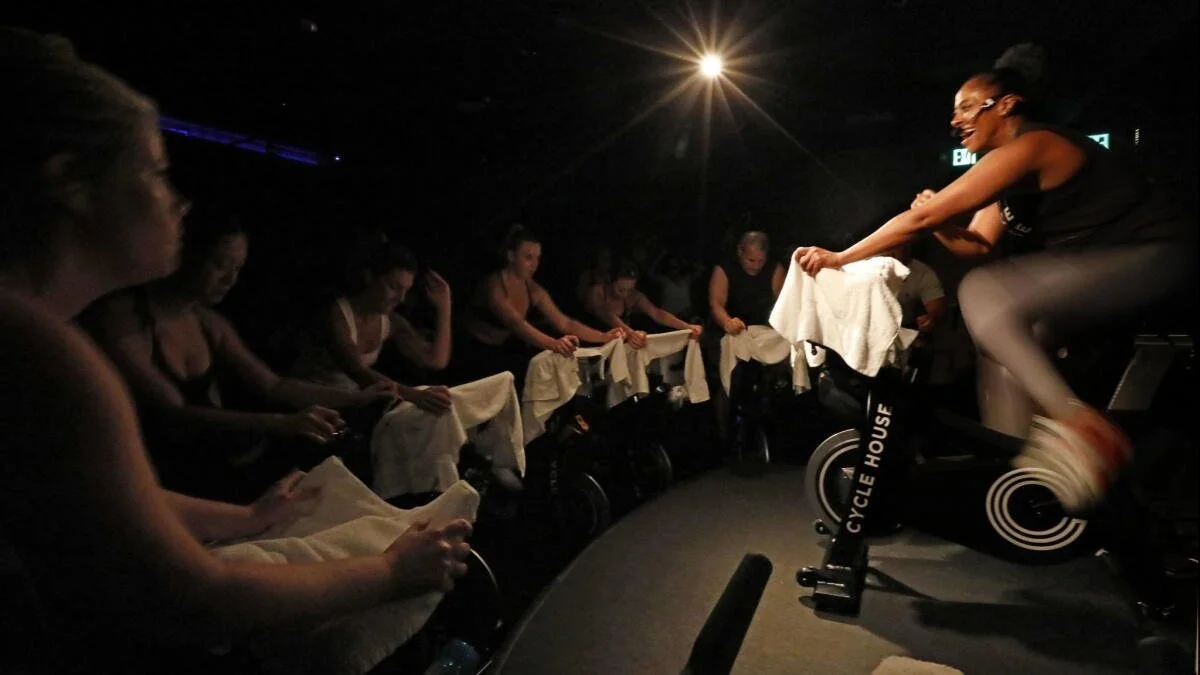
If you lived in LA in 2014, you did not simply work out. You went to Barry’s. You rode at SoulCycle. You did Orangetheory. If you moved in certain circles, you might have tried The Phoenix Effect; if you were especially image-conscious, you found your way to Cycle House on Melrose.
The price of entry was high enough to feel exclusive yet still within reach for a particular slice of the population. Inside, Taylor Swift’s “Blank Space” blasted while a room full of people pushed through intervals together. The experience was tribal, aspirational and, for a while, genuinely compelling.
What sustained it was a specific kind of consumer: affluent enough to spend serious money on self-improvement, image-conscious enough to care which studio they belonged to and optimistic enough about the future that recurring charges on the credit-card statement rarely prompted deep scrutiny.
Fitness had become lifestyle. Lifestyle had become identity. And identity, in that moment, was something you could buy by the month.
Then the conditions that made the model feel permanent began to shift.
COVID was the first and most visible rupture. Physical studios emptied almost overnight. Across the country, thousands of fitness businesses never reopened. SoulCycle’s footprint contracted. Orangetheory and other chains had to rethink a business model built around getting large numbers of people into enclosed rooms at regular intervals.
The rooms that had once felt like permanent fixtures of the city’s social infrastructure simply disappeared or contracted.
But the pandemic was only the beginning.
A second, slower pressure arrived through everyday economics. A $180 monthly membership looks different once inflation, higher housing costs, more expensive groceries, rising insurance premiums and the general accumulation of subscriptions have taken their toll.
The boutique model is particularly exposed to this kind of squeeze. A studio has limited square footage, a fixed number of class slots and a large base of unavoidable costs. When even a modest number of members stop renewing, the numbers can turn quickly. You cannot simply shrink the room by 20 percent and preserve the same economics.
A third change has been quieter and stranger.
For decades, one of the strongest motivations for enduring those high-intensity classes was the promise of visible transformation — especially on the scale. Work hard enough, often enough and the body would change.
Then GLP-1 drugs arrived.
Ozempic, Wegovy, Mounjaro and the drugs that followed have not eliminated the need for exercise. Strength, metabolic health, mood and longevity remain compelling reasons to move. Muscle loss associated with rapid weight loss has, in fact, given the fitness industry a new problem to address.
But culturally, something has shifted.
A pharmaceutical route now exists to one of the principal outcomes that once drove people into expensive group classes. That matters because the industry was never really selling exercise alone.
Running in Griffith Park is free. Walking the dog costs nothing. Weights at home or a competent YouTube session can deliver a perfectly respectable workout.
What the studios sold was motivation, community, identity and the feeling of belonging to a particular tribe. They sold the instructor. The music. The room. The ritual. The sense that you were one of the people who went there.
For a fleeting moment, that package proved extraordinarily powerful.
It becomes more discretionary, however, when people feel economically constrained — and when one of the central promises of the experience can be partially achieved elsewhere.
That is why the quiet closing of individual studios is more interesting than it first appears. It is a small piece of evidence for a larger cultural story: the fading of the particular LA fitness economy that belonged to the low-interest-rate, pre-COVID, subscription-happy 2010s.
The clues are ordinary rather than dramatic.
A storefront becomes another business. The signage comes down. The Instagram account stops posting. The membership offer vanishes from the website. There is rarely a grand announcement. No one writes the obituary.
Much of that era did not end with a crash.
A lot of it simply stopped renewing its membership.