Looking back, the years between roughly 2014 and 2016 now resemble more than a good period for Los Angeles. They marked a broader cultural inflection point. New forms of media were still expanding rather than consolidating, and the cultural landscape had not yet fragmented into quite so many competing streams of attention. Serial, which debuted in October 2014, demonstrated that long-form narrative podcasts could command mass audiences and effectively created the template that countless true-crime productions would imitate. HBO's The Leftovers, which premiered the same year, belonged to an era when prestige television increasingly rewarded ambition over algorithms. Meanwhile, AHS: Freak Show pulled in more than 6 million viewers for its premiere, a figure that would be difficult to imagine today.
What is striking is how distant that world now feels. Not historically distant, exactly, but culturally distant: twelve years ago, yet belonging to an entirely different media ecosystem. The platforms had not yet multiplied quite so completely, the audience had not yet fragmented quite so thoroughly, and the idea that millions of people might encounter the same piece of culture at roughly the same moment still felt relatively ordinary.
Instagram still functioned primarily as a place to discover rather than to perform, Uber felt like a civic innovation rather than a utility, and the creative economy retained a sense that independent ideas could still find audiences before being absorbed into larger platforms.
Los Angeles was perhaps the city that most visibly embodied that moment.
The city had always been sprawling, disconnected and oddly elusive. Its famous landmarks rarely lived up to the mythology, and getting from one neighborhood to another often felt like an expedition. But suddenly its separate worlds appeared to be converging. On weekends, people moved between Venice coffee shops, Fairfax boutiques, downtown galleries and Hollywood creative spaces, documenting a version of Los Angeles that felt both aspirational and accessible.
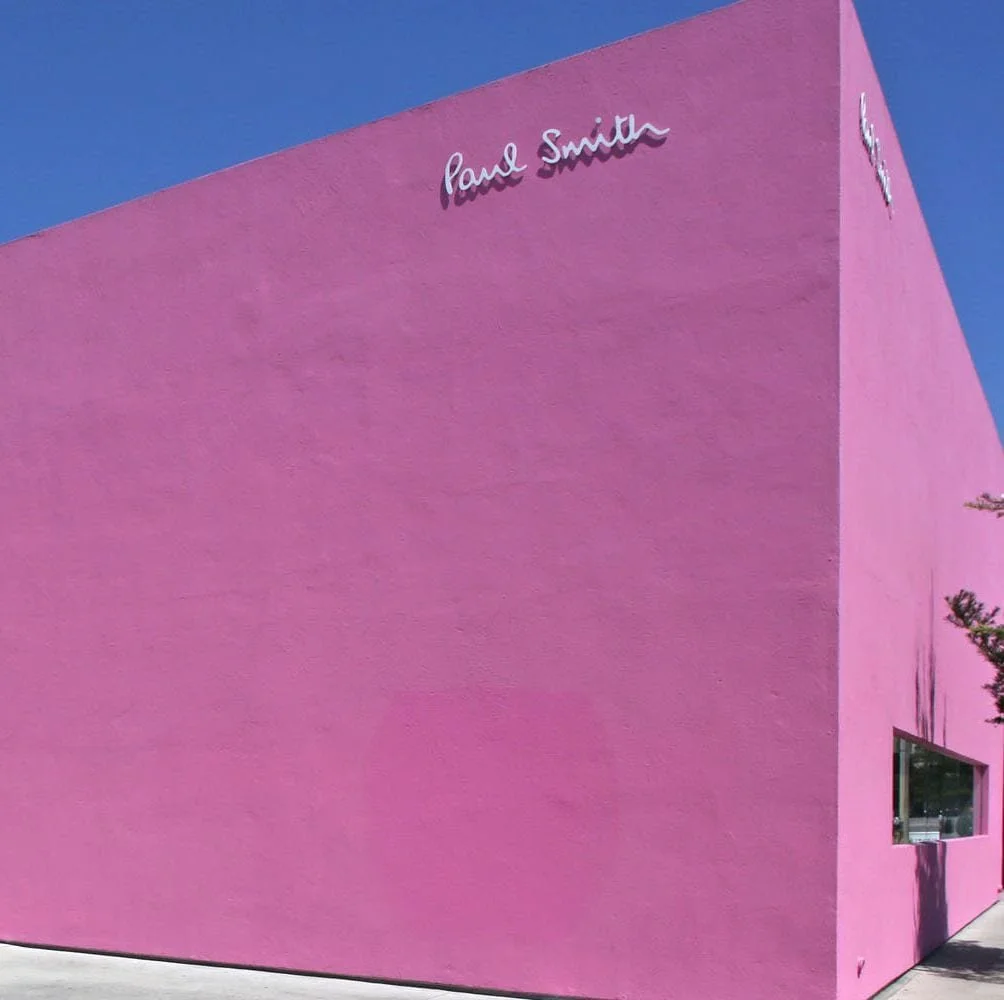
Everyone seemed to be chasing the same dream: the perfect shot outside the pink Paul Smith wall on Melrose, before hopping into an Uber and heading across town to whatever new restaurant, DTLA gallery opening or rooftop gathering had appeared that week.
It was a distinctly 2014 feeling. Instagram had transformed the city into a visual playground, but the underlying reality had not yet fully caught up. Neighbourhoods were becoming fashionable, yet they still contained enough unpredictability and affordability for ordinary people to participate. A person could still arrive with an idea, a little money and a willingness to experiment, and perhaps find a place within the city's expanding creative ecosystem.
The Los Angeles Renaissance
In Venice, the arrival of the Rose Hotel in 2014 captured that moment. More than a boutique hospitality concept, it helped legitimise a neighbourhood already gathering momentum. It contributed to a local ecology where hospitality, social life and cultural production overlapped. It functioned less as a hotel than as a social node, drawing together artists, founders, fashion people and international visitors and making Venice feel newly central.
Elsewhere, similar signals accumulated.
NeueHouse Hollywood opened in October 2015, formalising a new kind of infrastructure for the city's creative economy. It offered a physical home for entrepreneurs, designers, filmmakers and creative professionals whose work increasingly blurred the boundaries between technology, media and culture.
Hauser & Wirth opened in downtown Los Angeles in March 2016, reinforcing the idea that the city could support cultural institutions of international significance. The Los Angeles Metro Expo Line reached Santa Monica in May 2016, strengthening a still tentative belief that Los Angeles might begin operating less as a collection of disconnected enclaves and more as a coherent urban system.
Clifton's Cafeteria reopened in October 2015 after years of restoration, becoming a symbolic marker of downtown Los Angeles' revival and its aspiration toward civic reinvention. The Fairfax District, meanwhile, was consolidating its role as a hub for independent fashion retailers, streetwear brands and creative businesses.
Taken together, these developments created the impression of a city briefly in sync with itself.
The Infrastructure of an Open City
What made this moment possible was not prosperity alone, but the relative affordability of experimentation.
Rents were rising, but many neighbourhoods still contained spaces where independent operators could take risks. Operating costs were materially lower. Social media had not yet fully reorganised cultural life around algorithmic visibility. The expectation that every concept needed immediate scale had not yet become dominant.
Risk remained possible.
That mattered because cities rarely become culturally interesting through certainty. They become interesting when enough people can afford to experiment, fail and try again.
Many of the places that shaped this period were not important because they followed a proven formula. They mattered because they created environments where unexpected connections could occur.
Los Angeles has always relied on privately owned places to perform public functions. Unlike older European cities, where public squares and dense neighbourhoods naturally create interaction, Los Angeles developed much of its civic life inside cafés, cinemas, bookstores, bars, restaurants, hotels and cultural spaces.
These were commercial enterprises, but they also acted as civic infrastructure.
The Rose Hotel was not simply a hotel. Cinefamily was not simply a cinema. Against the Stream was not simply a meditation centre. Bar Mattachine was not simply a bar.
Their value came from the encounters they enabled.
They allowed people from different industries, backgrounds and social circles to occupy the same spaces long enough for friendships to form, ideas to circulate and collaborations to emerge.
The Closing Begins
The end of this period did not arrive as a single collapse. Some of the institutions associated with the Los Angeles renaissance continue to thrive. Hauser & Wirth remains a major cultural presence in downtown Los Angeles. The Expo Line continues to connect parts of the city that once seemed permanently separated.
But the broader ecosystem these places represented proved more fragile.
What began disappearing was not simply a collection of venues. It was the network of smaller, more improvisational spaces that allowed culture to develop around them.
The Rose Hotel's quiet disappearance in March 2020 now looks, in retrospect, like an early marker of that shift. The pandemic was the immediate cause, but the pressures were already building: rising rents, escalating operating costs, changing consumer habits and the increasing difficulty of sustaining independent businesses in desirable neighborhoods.
The lockdowns accelerated those forces. Some businesses never reopened. Others returned to a city whose rhythms had changed.
Cinefamily had already closed. Against the Stream disappeared around the same period. Clifton's Cafeteria, despite significant reinvestment and a celebrated reopening in October 2015, eventually succumbed to the challenges of operating a large historic venue in downtown Los Angeles and permanently closed this spring (2026).
Each case had its own circumstances. Together, however, they reveal a broader question: whether the kinds of idiosyncratic spaces that defined the mid-2010s can still survive in a city where the cost of operating has risen so dramatically.