Sunset Boulevard is one of Los Angeles’s great arteries. It runs more than 20 miles from downtown all the way to the ocean, passing through some of the most photographed stretches of the city. It cuts through Echo Park, Hollywood, West Hollywood and Beverly Hills, carrying the city from one version of itself to another. Even the Hollywood section still feels iconic — billboards, old theaters, the sense that you are moving through decades of images.
But the road becomes something else in a roughly mile-and-a-half stretch at the western edge of West Hollywood, just before it crosses into the manicured money of Beverly Hills. That is the part people still call the Sunset Strip: the neon, the giant billboards, the old rock clubs, the hotels that have appeared in a thousand movies. That is the part this is about.
When I moved to Los Angeles in 2014, a drive along that stretch still felt like moving through history. Restaurants, hotels, bars, clubs and shops filled the corridor. Tourists mixed with celebrities, people who wanted to be celebrities and people who simply liked being near the noise. The Strip still carried some of the old Hollywood charge that made the place famous.
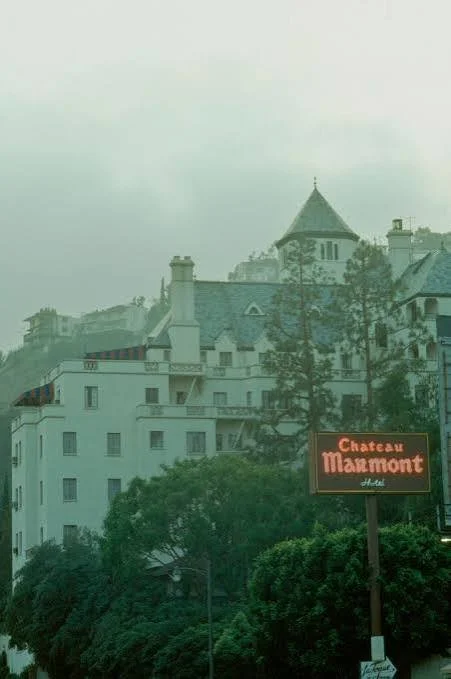
Pink Taco was there. The restaurants were packed. The bars were busy. The Standard had that slightly louche, groovy idea of what a Hollywood hotel should feel like. It is reopening this month as Public West Hollywood, an Ian Schrager project. The whole stretch felt theatrical. Of course, the Chateau still holds court.
But the important thing was not any individual restaurant or hotel. It was that people actually went there.
Today, much of it feels like a backdrop after the actors have left.
The buildings are still standing. The signs are still lit. The famous addresses have not moved. But increasingly they feel like advertising shells — structures selling a version of Los Angeles that does not quite exist anymore.
Los Angeles has become very good at maintaining the appearance of things after the underlying business has gone. A storefront stays. A sign stays. A luxury apartment goes up. A restaurant opens, closes and gets replaced by another restaurant. A hotel changes hands. A shopping center gets a new coat of paint. There is always another rendering promising that the next project will bring the street back to life.
But the ecosystem that made these places work is thinning out.
The Sunset Strip’s entire identity depended on density: enough people, businesses, nightlife, tourists and money concentrated in one corridor to create something greater than the individual pieces. Remove enough of those ingredients and the place starts to feel strange. A restaurant can survive without a busy street. A hotel can survive without a thriving neighborhood. A luxury retailer can live off destination shoppers. A Strip needs all of it happening at once.
That is what has changed. It is not simply that some businesses have closed. Cities have always had turnover. Restaurants fail. Hotels change names. Retailers move on. The real question is what replaces them — or whether anything replaces them at all.
Across Los Angeles, commercial vacancy has been climbing. Citywide retail vacancy reached 5.83 percent in the second quarter of 2026, the highest level in more than a decade. On some corridors, it is considerably worse. Santa Monica’s Third Street Promenade is the most visible example of what happens when a commercial district loses too many tenants at once.
The Strip has a different problem. It is not simply empty. It is hollow.
The connective tissue — the ordinary retail, the casual places, the bars, the restaurants and the reasons to come to the Strip in the first place — has thinned. And the Strip was never simply a collection of businesses. It was an ecosystem built around the idea of going out.
That idea is under pressure across Los Angeles. Eating out is becoming an occasion rather than a habit. Retail has moved online. Working from home has reduced the need to be anywhere in particular. Entertainment has become more fragmented. More of daily life can now happen without leaving the house. That is a very different kind of city.
The irony is that Los Angeles is still exceptionally good at selling the idea of Los Angeles. The Strip is wrapped in the visual language of glamour: palm trees, neon, billboards, expensive cars, famous names, rooftop pools and buildings that have appeared in movies and television for decades.
But the gap between the image and the actual experience is getting harder to ignore. You see it in empty storefronts and underused shopping centers, in businesses that seem to exist mainly as signage and in streets that are busy with traffic yet strangely quiet once you get out of the car.
The city is still busy. It is still wealthy. There are still tourists, celebrities, restaurants and hotels. What is disappearing is the ordinary commercial life that used to connect them.
That is why the Sunset Strip is a revealing stress test for Los Angeles. Its entire brand was built on concentrated glamour, nightlife and the promise that something was happening here. If even a place with that much history and cultural recognition cannot sustain the full ecosystem that made it famous, the problem is larger than a few vacant storefronts.
The lights are still on.
But is anyone home?