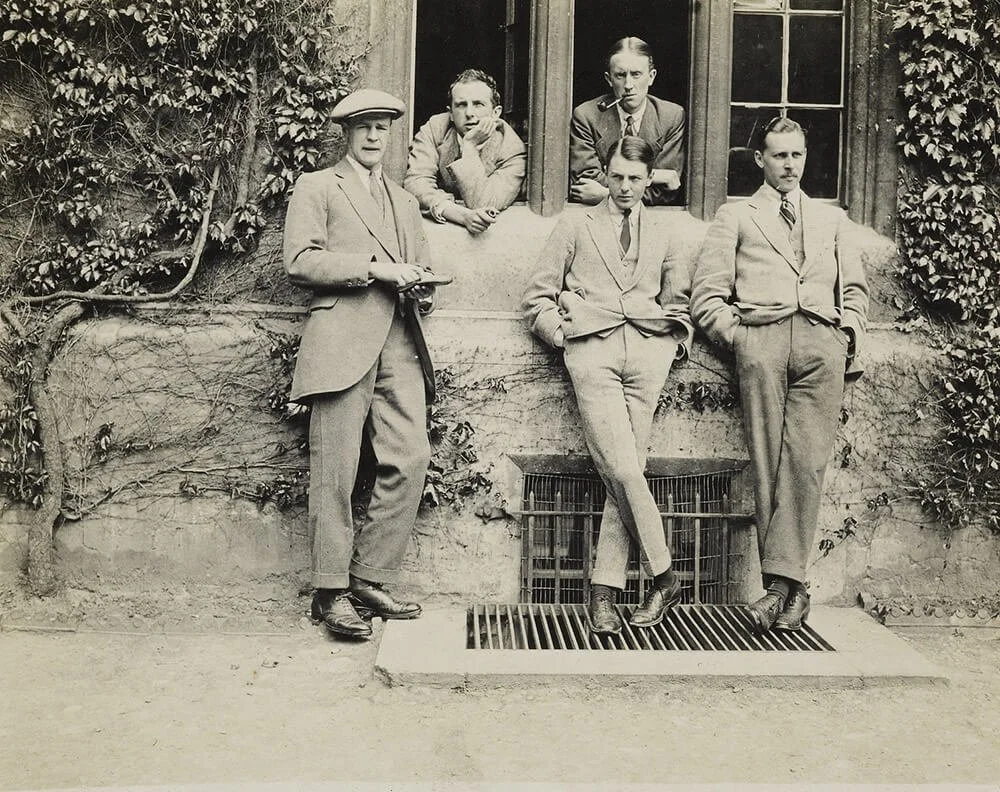
Much like its playing fields and sports, Britain’s gift to the world of literature is boundless. From Geoffrey Chaucer to William Shakespeare, from the Brontë sisters to Charles Dickens, Britain produced writers who helped define the English language itself. Their works mapped human character, social order, and moral consequence with a precision that would shape literature far beyond the island.
Yet Britain’s influence runs just as powerfully through a different tradition: children’s literature and fantasy.
In the late 19th and early 20th centuries, figures like Rudyard Kipling, author of The Jungle Book (1894), A. A. Milne, whose Winnie-the-Pooh appeared in 1926, and later C. S. Lewis and J. R. R. Tolkien, did not simply tell stories—they built worlds. These were not merely tales for children, but acts of imaginative architecture: fully realized universes with their own internal logic, moral gravity, and, in Tolkien’s case, even languages. Tolkien’s The Lord of the Rings (1954–55) and Lewis’s The Lion, the Witch and the Wardrobe (1950) would go on to define modern fantasy.
Why England? Why then?
Part of the answer lies in the nature of British society at the time. At the height of its empire, Britain occupied a paradoxical position: global in reach, yet physically rooted on an island. It encountered distant cultures without fully dissolving into them. That tension fostered not just awareness of the “elsewhere,” but a habit of imagining it—of constructing worlds that were foreign, ordered, and legible.
At the same time, industrialization was transforming daily life. Cities expanded, systems grew more bureaucratic, and the rhythms of existence became increasingly mechanical. In response, many writers turned away from the present—toward pastoral landscapes, mythic pasts, and self-contained moral worlds that stood apart from modernity. In Tolkien’s Middle-earth, forests replace factories, fellowship replaces hierarchy, and meaning emerges not from systems, but from choices.
There was also a deep well of myth to draw from. England did not inherit a single, unified mythological canon. Instead, it sat atop layered traditions—Celtic, Anglo-Saxon, Norse, and Christian—fragmented, overlapping, and often half-remembered. Writers like Tolkien did not simply borrow from these sources; they sought to reconstruct something larger from them, assembling a mythic inheritance that England itself had never fully consolidated.
Education reinforced this impulse. The same school systems that emphasized discipline, structure, and character formation also cultivated a tradition of moral storytelling. Literature was not treated as mere entertainment, but as a vehicle for meaning—an idea clearly visible in the work of Lewis, where narrative and moral vision are inseparable.
And then there was war. The experience of World War I shattered older assumptions about progress and heroism, exposing a scale of mechanized destruction that realism struggled to contain. For writers like Tolkien and Lewis, fantasy offered another way forward—a means of grappling with loss, courage, and the nature of evil while restoring a sense of moral coherence to a fractured world.
Taken together, these forces produced something distinctive. Not a monopoly on great literature, but a particular convergence of global exposure, historical depth, and imaginative ambition—one that gave rise to stories capable of transcending their time and place.
If the playing fields of England taught the world how to compete within rules, its literature taught it how to imagine beyond them.