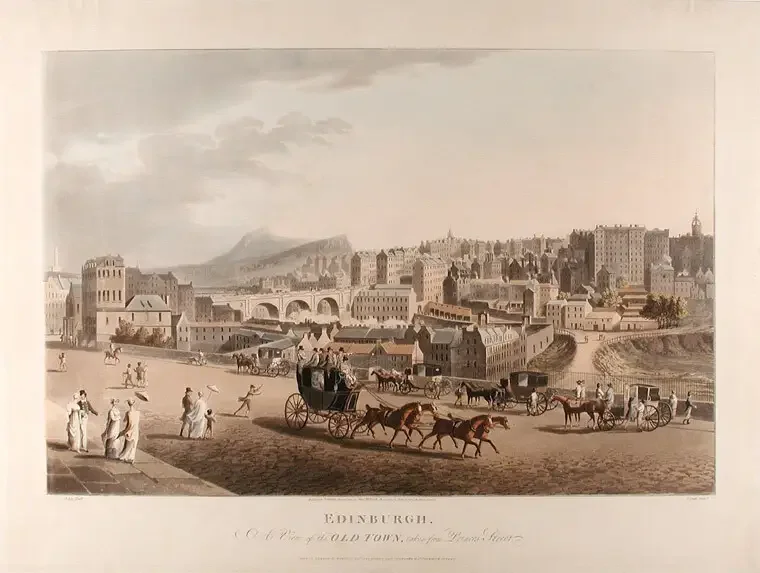
Walk through Edinburgh, and you walk through time.
The city rises in layers—medieval closes and wynds, Renaissance facades, and the ordered geometry of the Enlightenment New Town. Each era builds on the last, forming not just a skyline, but the intellectual scaffolding of the modern world.
In the second half of the eighteenth century, something remarkable happened here. In a country of just one and a half million people, a concentration of thinkers emerged whose ideas would ripple far beyond Scotland—helping shape the philosophical and economic foundations of the United States.
Adam Smith published The Wealth of Nations in 1776—the same year America declared independence. His ideas about free markets, competition, and the “invisible hand” didn’t just redefine economics; they influenced figures like Alexander Hamilton and informed the economic framework of the new republic.
David Hume, meanwhile, dismantled assumptions about certainty itself. By questioning how we know anything, and insisting on reason over superstition, he helped shape the intellectual climate that influenced American thinkers such as Thomas Jefferson and James Madison—men tasked with turning abstract ideals into a functioning system of governance.
Then there was James Hutton, who looked not to politics but to the earth beneath our feet. In uncovering the concept of deep geological time, he laid the foundations of modern geology. His insistence on observation and evidence helped model a way of thinking that would influence generations of American scientists and engineers, embedding inquiry and experimentation into the nation’s DNA.
But beyond any single figure, it was the atmosphere of Scottish Enlightenment itself that mattered most. Edinburgh was a city of salons, societies, and argument—a place where ideas were tested, challenged, and refined. Americans who studied these works, or traveled here, encountered not just theories, but a method: debate, empiricism, and a belief that society could be improved through reason.
The Enlightenment in Edinburgh didn’t stay in Edinburgh.
It crossed the Atlantic in books, in letters, in minds—and helped shape a new kind of nation, one that sought to move beyond inherited European models toward something more experimental, more self-determined.
Walk these streets today, and you’re not just passing through history.
You’re walking through the ideas that built the modern world.