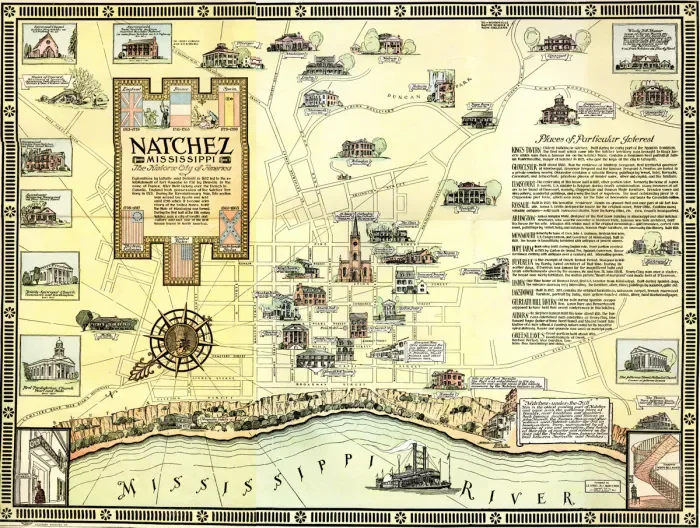
Founded by the French in 1716, Natchez takes its name from the Natchez people, whose homeland occupied this stretch of the Mississippi River for centuries before European settlement. The city's history is therefore far older than its colonial founding. Long before Natchez became synonymous with grand mansions and spring pilgrimages, it owed its success to geography.
Perched high above the Mississippi River on one of the few natural bluffs along its course, Natchez became an important trading settlement long before the Civil War. Under French, British, Spanish and eventually American rule, it served as a gateway between the fertile interior of Mississippi and the global marketplace. By the early nineteenth century, merchants, bankers, riverboat operators and cotton brokers had transformed the town into one of the South's busiest commercial centers.
Everything changed after 1793 with the invention of Eli Whitney's cotton gin. Suddenly, short-staple cotton—which thrived across much of the Deep South—could be processed efficiently and profitably. As European demand for cotton cloth accelerated during the Industrial Revolution, Mississippi found itself at the center of a booming international economy.
By the 1850s, Manchester, England had earned the nickname "Cottonopolis," its textile mills consuming staggering quantities of raw cotton. Lancashire wove what Mississippi grew. The United States supplied roughly three-quarters of Britain's imported cotton, making the crop America's most valuable export and binding the economies of Britain and the American South together in a remarkably interdependent relationship.
Natchez prospered accordingly. Cotton poured downriver to New Orleans before crossing the Atlantic to Britain's mills. Banks financed plantations, merchants supplied them, and fortunes accumulated with astonishing speed. Wealthy planters often maintained elegant townhouses in Natchez while overseeing vast plantations scattered across the surrounding countryside. By the eve of the Civil War, Natchez ranked among the wealthiest communities in the United States on a per-capita basis.
Yet that prosperity rested upon an uncomfortable foundation.
Cotton was extraordinarily labor-intensive, and after Congress prohibited the international slave trade in 1808, the expanding plantations of Mississippi relied on the domestic slave trade to meet their labor demands. Hundreds of thousands of enslaved men, women and children were forcibly relocated from older states such as Virginia and Maryland to the Deep South in what historians describe as the Second Middle Passage. Natchez became not only a major cotton market but also one of the nation's principal centers for the buying and selling of enslaved people. The wealth that financed its magnificent homes, churches and civic buildings was, in overwhelming measure, created through enslaved labor.
That paradox continues to shape Natchez today.
Tourism often celebrates the city's remarkable architectural legacy while struggling to present the fuller history that made such grandeur possible. Nowhere is this more evident than during the annual Pilgrimage, when homeowners open antebellum mansions to visitors, dressed in period costume and recounting stories of prominent families, refined society and architectural elegance. For decades, these narratives often softened or omitted the central role slavery played in creating the wealth on display.
In her documentary Natchez, filmmaker Suzannah Herbert does not portray these tours as isolated curiosities. Instead, she presents them as the continuation of a mythology long cultivated through popular culture—a version of the Old South populated by gracious belles and genteel gentlemen while the labor that sustained their world remains largely offstage. By peeling back that carefully maintained performance, Herbert reveals not only the gap between memory and history, but also how the South itself has often been presented as a genre as much as a geography.