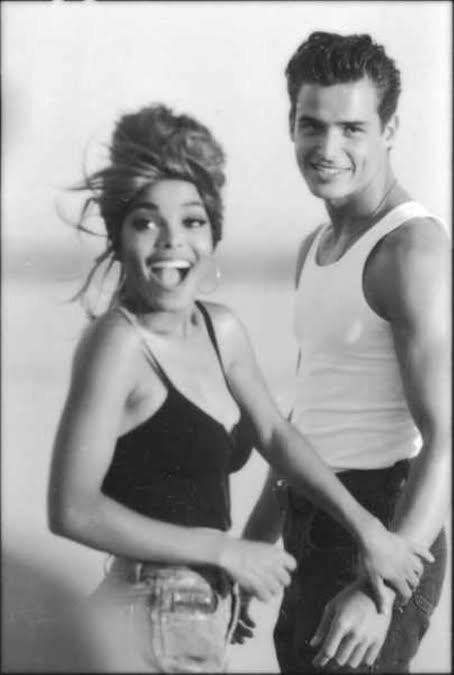
Having just experienced the most depressing Fourth of July ever, as America’s 250th birthday passed with barely a whimper, I find myself thinking about what first attracted me to the idea of America, and it all stems back to 1990 when the single "Love Will Never Do (Without You)" by Janet Jackson was officially released.
The Herb Ritts-directed music video was like nothing I had ever seen. Today, it still takes my breath away. Bathed in that warm, golden desert light, Janet—confident, sensual, radiant in a simple black top and jeans—dances with effortless beauty alongside Djimon Hounsou and Antonio Sabàto Jr. It wasn’t just a music video. It was a cultural artifact: polished, aspirational, unapologetically American in its glamour and optimism.
At age 14, watching it in rain-soaked England, I fell in love with the idea of America that beamed through that television screen. These icons were projected across the world, and we naturally thought this was what most Americans looked like: confident, vibrant, stylish, and effortlessly cool. Back then, pop culture still produced big, beautiful, shared experiences instead of endless algorithmic fragments. Janet wasn’t just the most beautiful woman on screen; she embodied a broader cultural peak of American excellence.
In 1990, culture wasn’t yet fragmented by infinite scrolling, ragebait, and democratized mediocrity. Videos like Ritts’ were crafted with intention, lit like art, and broadcast to a mass audience that experienced them together. Today’s aesthetics often feel cheap and ugly by comparison: over-filtered, low-effort, designed for clicks rather than timelessness. The golden light feels replaced by cold blue screens and declining standards across media, architecture, and public discourse.
This isn’t simple nostalgia. It’s grief for a version of the American experiment that felt like it was delivering—prosperity, beauty, relative social cohesion, and forward momentum. The country didn’t collapse after 1990, but something vital shifted. The unifying optimism gave way to endless grievance, institutional skepticism, and visual and cultural coarsening. We traded Herb Ritts’ desert glow for dystopian feeds and hollow spectacle.\
Janet’s video remains a time capsule. It reminds us what peak American popular culture looked like: glamorous, integrated, confident, and bathed in light. Recapturing that spirit—refusing the cheap and ugly, demanding excellence again—might be the only way to move beyond the precipice we crossed. The American Dream didn’t end in 1990. But we lost sight of its shine, and we’ve been living in the shadow ever since.