When I moved from Britain to the United States, I expected differences.
I expected different accents, different food, different politics, different ways of doing business.
What I did not fully appreciate was how much the landscape itself shapes the way people think.
Weather is one of the clearest examples.
Growing up in Britain, weather was mostly something to complain about. It was a conversation starter, a reason to carry an umbrella, a topic for small talk. It could be inconvenient and occasionally disruptive, but rarely existential.
“Leaves on the line” was a national joke — the annual autumn moment when falling leaves somehow brought our railway system to its knees. We sighed, rolled our eyes, put the kettle on, and waited for things to return to normal.
A cold snap might cause a few problems. A heat wave might make headlines, perhaps alongside stories of hosepipe bans or, in the unforgettable summer of 1976, an invasion of ladybirds.
But there was a quiet assumption underneath it all:
This too shall pass.
Then I moved to America.
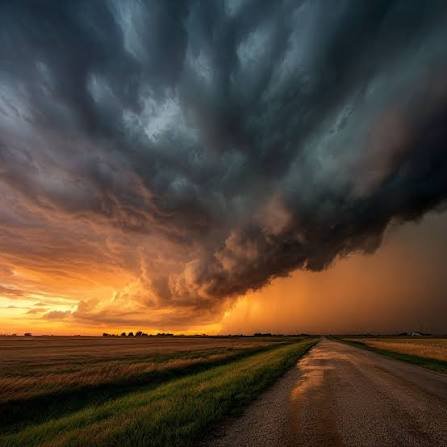
Here, weather has a different personality. It has a different scale, a different intensity, and sometimes a different relationship with danger.
I personally experienced that during the Palisades Fires in January 2025. I had to evacuate, driving down the mountain through gale-force winds while debris was being hurled against the car windscreen. It was not just the fire itself that created the danger; it was the wind acting as a force multiplier, turning a wildfire into something faster, more unpredictable, and more threatening.
That was a moment when weather stopped being something to discuss and became something to respond to.
In the United States, weather is not just something that happens outside the window. It can be a force that changes lives.
A hurricane can empty entire towns. A wildfire can move across hundreds of thousands of acres and force evacuations. A thunderstorm in the mountains can turn a peaceful creek into a deadly flash flood. A summer heat wave can become a public health emergency.
The first time you experience an American weather alert, there is often a moment of adjustment.
The language itself feels different.
It is not:
“Bring an umbrella.”
It is:
“Seek shelter.” “Evacuate.” “Move to higher ground.”
The difference is not that Britain has no dangerous weather. Of course it does. Flooding, storms, and heat waves can and do cause harm.
But the scale and volatility of weather across much of America creates a different relationship with risk.
Part of this comes down to geography — something I have only really learned by living here.
Britain sits in the embrace of the Atlantic. The same ocean that brings rain also moderates the climate. The Gulf Stream helps keep the British Isles remarkably mild for their latitude. Winters are softened (usually). Summers are restrained (not always). Extreme swings are relatively rare.
The eastern United States, by contrast, sits at the meeting point of enormous forces. Arctic air can sweep south from Canada. Tropical moisture can rise from the Gulf of Mexico. Warm ocean currents can provide energy for powerful storms. A vast continent allows temperatures to swing dramatically.
The Atlantic that acts like a thermostat for Britain can become an engine of extremes for America.
And the lesson is not just meteorological.
It is cultural.
People who grow up in different environments absorb different assumptions about how the world works.
A Brit may grow up with the expectation that disruption is temporary and that established systems will usually absorb the shock.
An American may grow up with more of an expectation that preparation is personal: have insurance, have savings, have a plan, know what to do when the warning arrives.
Neither mindset is right or wrong. They are adaptations to different environments.
Perhaps this is why Britain and America can feel so fascinatingly similar and yet so different.
We share a language. We share much of our history. We consume many of the same books, films, and television shows.
Yet beneath that shared language are different experiences of the world.
A British person and an American may use the same words — “storm,” “risk,” “security,” “emergency” — but those words can carry different emotional weight because they were formed in different landscapes.
The differences extend beyond weather.
They appear in attitudes toward healthcare, government, personal responsibility, money, and uncertainty.
Growing up in Britain, I was shaped by one set of assumptions about how life works. We all watched the BBC. We all understood the NHS as a national institution. There was a shared sense that certain systems existed around you.
Living in America, I encountered a very different reality: a vast country where many essential systems vary dramatically by state, employer, and individual circumstance. The expectation is often less that a single national structure will catch you, and more that you must understand, navigate, and protect yourself within a complicated landscape.
The surprising thing is that neither culture is simply better.
They are responses to different realities.
Britain often feels like a place built around stability: old systems, moderation, continuity.
America often feels like a place built around possibility and unpredictability: enormous opportunities, enormous challenges, and the need to adapt quickly when circumstances change.
Perhaps that is why two nations can share a language and still sometimes feel like they are speaking different dialects of thought.
The Atlantic connects us.
Geography separates us.
And sometimes, the weather tells the story better than anything else.