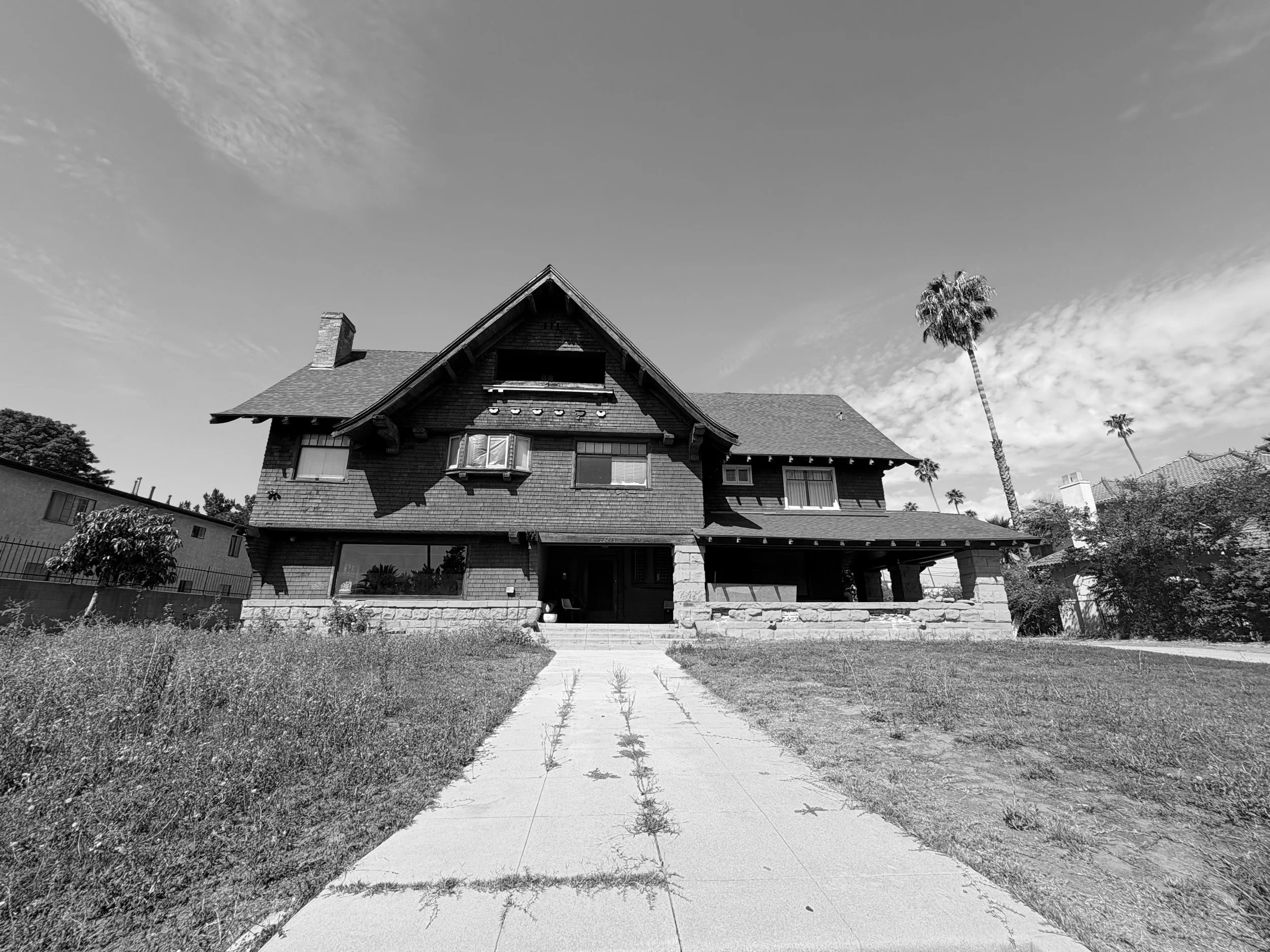
In the historic neighborhoods of West Adams and Country Club Park, grand early-20th-century mansions stand as silent witnesses to Los Angeles's Gilded Age — and to the city's enduring fascination with death, mystery and the supernatural.
Some became famous because Hollywood made them frightening. Others have histories that are unsettling enough without any help from the movies. Convents, funeral homes, murder houses, family tragedies and even a dynamite attack all figure into the stories behind these imposing residences.
Here is a short tour of five Los Angeles houses where real history and fictional horror collide.
1. 1120 S Westchester Place — Rosenheim Mansion / AHS Murder House
Built in 1908 by architect Alfred Rosenheim as his own Tudor Revival residence, this imposing Country Club Park landmark was designed as a showcase of early Los Angeles wealth, with Italian brickwork, Peruvian mahogany and Tiffany glass. A former chapel was later converted into a recording studio.
For decades, however, the mansion had a very different life: it was used by the Sisters of Social Service before eventually becoming a private residence.
Its most famous incarnation is entirely fictional. The mansion became the "Murder House" in the first season of American Horror Story, with its exterior and some interiors filmed on location while other scenes were recreated on sets. It returned in later seasons and spin-offs.
Today, fans continue to seek it out — something that has reportedly been considerably less welcome to the property's later owners.
2. 2215 S Harvard Boulevard — Thomas W. Phillips Residence (pictured)
Built in 1905 by architects Sumner B. Hunt and Abraham Wesley Eager, this 7,707-square-foot Craftsman mansion was constructed for Thomas W. Phillips, one of early Los Angeles's prominent residents.
The house became the Robeson family residence in Wes Craven's The People Under the Stairs (1991), where the grotesque "Man" and "Woman" imprison victims beneath their home. The production transformed the stately Craftsman into one of the most unsettling domestic spaces in horror cinema.
The property later doubled as the Myers kitchen in Rob Zombie's Halloween (2007) and appeared in The Immortalizer, The Convent and other productions.
3. 2263 S Harvard Boulevard — Frederick Hastings Rindge House
Built around 1902–1904 for Frederick Hastings Rindge and his wife, May Knight Rindge, this imposing Romanesque Revival mansion belonged to the same Rindge family whose name is inseparable from Malibu.
Frederick Rindge was one of Southern California's wealthy industrialists. In 1892, he and May acquired the enormous Rancho Malibu Spanish Land Grant, making the family owners of what was then one of the region's great private estates. After Frederick's unexpected death in 1905, May inherited the fight to keep Malibu private.
For decades, she battled railroads, roads and developers who wanted access to the family's enormous coastal property. Her determination eventually made her known as the "Queen of Malibu" and turned the Rindges' struggle into one of Southern California's great property battles.
May herself died in the Harvard Boulevard mansion in 1941.
After the Rindges, the house became a convent and later a maternity home. It has also appeared in films and television.
4. 2421 S Figueroa Street — Stimson House
Known as the "Red Castle," this extraordinary 1891 Richardsonian Romanesque mansion was designed by Carroll H. Brown for lumber millionaire Thomas Douglas Stimson. It was reportedly the most expensive private residence in Los Angeles when completed.
And five years later, someone tried to blow it up.
In 1896, dynamite was placed against the house's foundation, directly beneath Stimson's bedroom. The resulting explosion damaged the area around the mansion but failed to destroy its massive sandstone walls. Neighbors reportedly saw a man fleeing the scene and fired after him.
5. 2302 W 25th Street — Six Feet Under House
The Auguste Marquis Residence, dating to around 1904–1905, is an imposing Queen Anne/Eastlake-style house and a Historic-Cultural Monument.
Television audiences know it as something else entirely: Fisher & Sons Funeral Home, the home and workplace at the center of HBO's Six Feet Under.
The real house has its own long history. It was originally built for a Swiss mining figure and later became associated with the founder of the Filipino Federation of America, which continues to occupy the property.