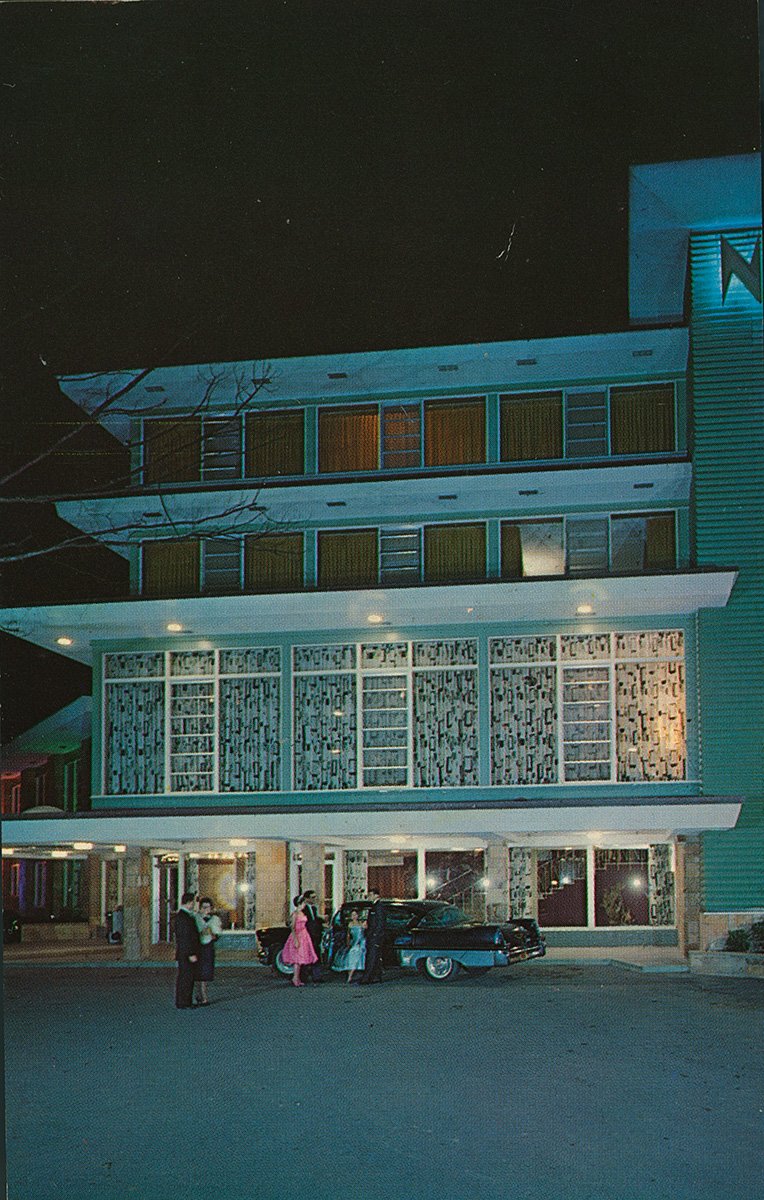
Nothing about the Nevele is quite what it appears to be.
Take the Hawaiian-themed Waikiki indoor pool. Designed in 1954 by architect Sydne Schleman, its yellow-and-green ceiling ornaments, bridge, cascading waterfall and distinctive pineapple chandelier were not simply decorative flourishes. The pool was the crown jewel of an ambitious health-club complex, a piece of mid-century spectacle designed to make the resort itself the destination. Guests could dance poolside on the adjoining patio, surrounded by an entirely manufactured tropical fantasy in the middle of the Catskills.
And that was the point.
The Nevele was part of a vast postwar vacation machine built around the enormous Jewish leisure market that had developed in the Catskills. Hundreds of rooms, restaurants, indoor and outdoor pools, golf, skiing, skating, entertainment and conference facilities were assembled into a self-contained world in which guests could eat, exercise, socialize and be entertained without ever needing to leave the property.
For decades, that model worked extraordinarily well.
But by the 1980s and 1990s, the economics that sustained the Borscht Belt were changing. Affordable air travel opened up Florida, Europe and other destinations. Cruises and new forms of resort travel offered experiences the Catskills could no longer monopolize. The long summer and winter stays that had once filled enormous properties became increasingly difficult to sustain.
The Nevele's greatest asset became its greatest liability: its sheer size.
A resort designed around an enormous volume of guests still required an enormous amount of money to operate, maintain and staff. By the time the property finally failed, the infrastructure that had once made the Nevele spectacular had become an extraordinary financial burden. In 2011, the resort reportedly owed roughly $20 million to creditors, while its assessed value was cut from $15 million to $5 million.
And yet the physical place did not disappear.
The ten-story dodecahedral tower, ice rink, ballrooms and pools remained standing, largely untouched, for years. Successive redevelopment proposals came and went. Some treated the existing structures as assets worth preserving rather than simply demolishing them. The resort became something stranger than an abandoned hotel: a remarkably complete physical remnant of an entire vacation economy.
The circumstances of the final collapse only added to the mythology. The closure was abrupt. Employees and creditors were left unpaid. An auction was canceled. A mysterious foreign buyer reportedly appeared and then failed to materialize. Ownership disputes and litigation dragged on as the property sat dormant.
But beneath the mystery was a simpler story.
The Nevele did not die because its fantasy had stopped being impressive. It died because the world that had made that fantasy economically viable had changed.
What disappeared was not just a hotel. It was a particular way of spending leisure time: an immersive, self-contained resort culture built for a postwar generation that once arrived in the Catskills in enormous numbers — and eventually found other places to go.