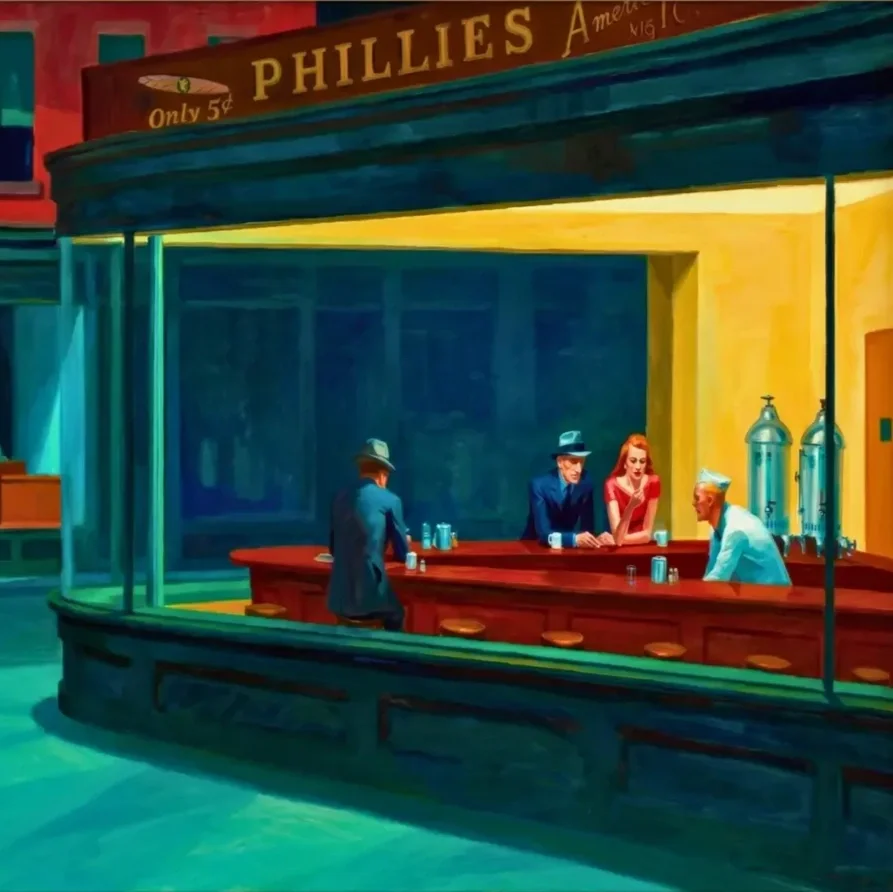
I have always thought there was something rather sophisticated about eating alone. It requires a certain confidence about occupying public space without needing to explain why you are there. You can walk into a restaurant, sit down by yourself and have breakfast simply because you want breakfast. There doesn’t have to be another person involved, and there doesn’t have to be a particular occasion attached to the meal.
The American diner was exceptionally good at accommodating this. The counter was one of the great pieces of social architecture because it gave the solitary customer a completely natural place in the room. You could sit among strangers without having to interact with them. You could read the paper, drink coffee, watch the staff working and listen to fragments of other people’s conversations. You were surrounded by people without being required to join them.
That seems increasingly difficult to find.
COVID obviously didn’t invent the decline of the diner counter, but it seems to have accelerated it. When restaurants were forced to remove stools and space tables apart, operators discovered that the new arrangements could make more economic sense. A counter occupied a considerable amount of valuable floor space while accommodating customers who, by definition, were likely to spend less than a family or a group. Once restaurants had invested in new layouts, outdoor seating and different service models, there wasn’t much financial incentive to reconstruct the old arrangement when restrictions disappeared.
The labor situation reinforced the change. The old counter was based on a particular kind of restaurant service, with someone continuously working that narrow strip of real estate, taking orders, pouring coffee, clearing plates and turning over seats. At a time when restaurants were dealing with higher labor costs and difficulty finding staff, that model was not necessarily attractive. Meanwhile, the customers who had once populated counters — office workers grabbing breakfast, people stopping somewhere alone after work, regulars dropping in for coffee — were no longer as predictable, particularly as remote work changed the daily rhythms of American cities.
What is interesting is that the change has now become cultural as well as economic. Walk into many newer restaurants and the room seems to assume that people will arrive in groups. There are large tables, banquettes and family-sized arrangements, often in spaces designed around the idea of a busy social occasion. The person who walks in alone is still perfectly entitled to eat there, but the room no longer necessarily makes that person feel as though it had been designed with them in mind.
I noticed this recently when I went for breakfast somewhere that had once had the kind of terrace and seating arrangement that made eating alone completely unremarkable. The counter had disappeared, and most of the room was occupied by large tables. I found myself surrounded by families and groups of perhaps ten or fifteen people, and although nobody was paying the slightest attention to me, I suddenly became very conscious of being there alone.
That feeling is difficult to explain because nothing objectively unpleasant has happened. Nobody has made you feel unwelcome. The restaurant has not refused to seat you. But the physical arrangement of the room tells you something about the sort of customer it expects to see. When almost every table is designed for a group, a single person becomes visually conspicuous in a way that they never were at the counter.
This is what I think we have lost with the disappearance of that kind of seating. The counter allowed you to participate in public life without necessarily participating socially. You could be around other people while remaining entirely in your own world. There was no expectation that you should be talking, celebrating, sharing or even particularly enjoying yourself in the conventional sense. You could simply sit there with your breakfast and your newspaper while the restaurant carried on around you.
There is something quite civilized about that arrangement, and perhaps something particularly appealing about it now. We live in a culture that has become increasingly concerned with being connected, included and accompanied, while the ability to spend an hour in public entirely on your own is treated almost as an eccentricity. Restaurants increasingly reflect that change. They are places for couples, families, friends, birthdays and groups, rather than places where a person can simply turn up and occupy a small piece of the room.
Of course, eating alone has not disappeared. You can still sit at a bar, find a small table in a café or have dinner by yourself. But the experience has changed when the architecture around you assumes that the natural customer arrives with other people.
That is why I miss the diner counter. I miss the social permission it quietly provided. It made being alone in public seem so ordinary that you didn’t have to think about it at all.
And perhaps that was its greatest virtue: nobody had to tell you that you belonged there. The room had already made the argument for you.