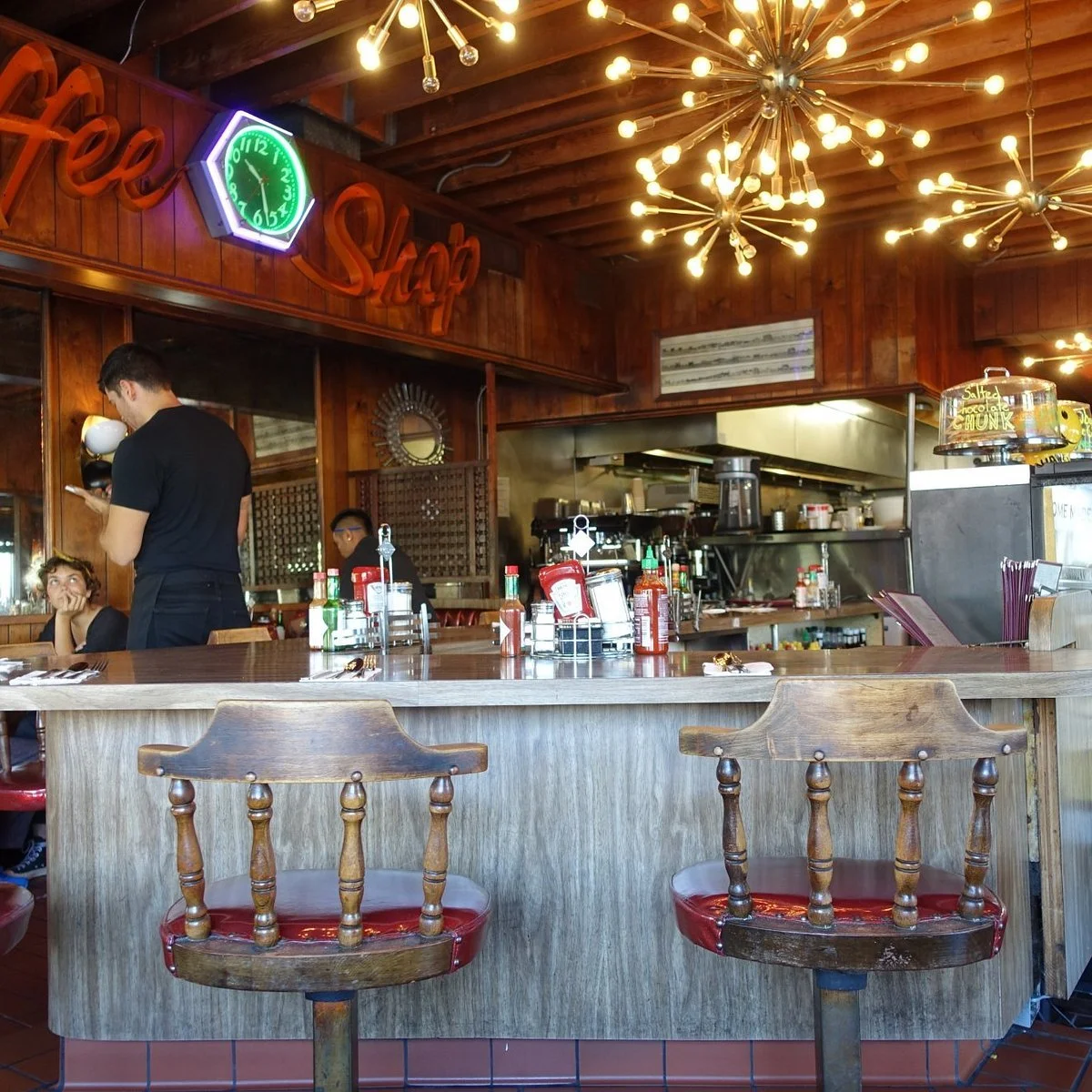
I am becoming increasingly protective of places that are just… places. The coffee shop designed for sitting rather than photographing. The diner that never needed a concept. The room that exists because people need somewhere to be, not because someone needed content.
This is not about preserving venues in amber like nostalgic relics. Remember when Clueless had a pop-up café in the early pandemic? As if. The goal isn’t to freeze the past. It’s to notice when the present quietly decides that certain kinds of ordinary life are no longer worth the rent.
Brite Spot opened in Echo Park in 1949, long before the neighborhood became shorthand for a particular kind of creative class. For decades it was the sort of place that did not need to explain itself: chrome, vinyl, coffee, bacon, eggs, pie. A late-night refuge. A hangover breakfast. A place where you could order corned beef hash with over-easy eggs and a side of bacon without wondering whether the meal had been optimized for Instagram.
That kind of place became increasingly hard to sustain.
The online reaction to Brite Spot’s decline was revealing. People remembered the food, the location, and especially the role it once played. But they also described a restaurant caught between worlds: a diner that was no longer quite a destination, in a neighborhood that was becoming increasingly expensive, with repeated closures and reboots that gradually eroded whatever loyalty remained.
One observation captured the problem particularly well: it was difficult to sustain a greasy-spoon diner in a neighborhood increasingly filled with one-bedroom apartments renting for $4,000 a month.
The Echo Park around the diner changed. So did the economics of the city. The people who had once stumbled into Brite Spot after a night out were increasingly being priced out, while the people moving into the neighborhood arrived with different expectations of what a restaurant should be. That does not mean they did not want breakfast. It means the cultural ecosystem that supported the old kind of breakfast place was disappearing.
Brite Spot closed during the pandemic, reopened, and closed again. Stuart Weisfeld took over and managed to keep the lights on for a time, but the restaurant eventually closed once more. There were further attempts to revive it, but the pattern had become unmistakable: closure, reopening, reinvention, closure.
At some point a restaurant can survive its original audience but not its original purpose.
And that may be what happened to Brite Spot.
There is something particularly sad about the disappearance of a place like this because nobody has to declare it obsolete. There is no grand announcement that the old Los Angeles has ended. The change happens incrementally. The diner closes. Someone tries to revive it. The revival does not quite work. Another restaurant appears. The apartments get more expensive. The old regulars move elsewhere.
Then one day you realize that the city you remember is mostly accessible through photographs.
Brite Spot was one of the first places I visited when I arrived in Los Angeles over a decade ago. I did not know then that I was arriving near the end of something. That is perhaps what makes old Los Angeles so difficult to mourn. There was no single moment when it disappeared. It simply became harder to find. And then, eventually, places like Brite Spot stopped being there at all.