When I first came to Los Angeles, I stayed in a magical house at the top of a vertiginous street in Franklin Hills, just up from a crazy six-way intersection at the edge of Hollywood Boulevard, by (what is now) Tarantino's Vista Theatre. I had arrived from London, where I had spent years imagining Los Angeles through films, magazines and television (mostly Columbo), but nothing quite prepared me for the physical reality of it.
From the deck, the city seemed to roll away beneath a canopy of trees. Who knew LA was so green?
The hills disappeared into one another, houses appeared and vanished among the foliage, and at certain times of day it felt less like a city than some improbably beautiful garden. I remember thinking that this was what Los Angeles was supposed to be: slightly unreal, sprawling, glamorous and somehow still wild. It felt like Eden.
Los Angeles is a city that keeps its secrets close. If all you know of it is the freeways, the traffic and the places tourists are supposed to see, it can be difficult to understand why anyone falls in love with it. The city reveals itself differently when you know someone who knows someone — when you are invited into a house in the hills, taken to a bar you would never have found, or driven across town to a little pocket of life that seems to exist entirely apart from the Los Angeles you thought you knew.
I had already fallen a little bit in love with the city on my first visit, in February 2006, when I came to Los Angeles from London. I barely understood it geographically. I remember the enormous distances, the hills and the strange little pockets of life scattered across them. Through a mutual acquaintance back home, I met some cool people and got a glimpse of a Los Angeles that felt private and slightly inaccessible. I left with the sense that this might be somewhere I could imagine living one day.
I came back the following year, in September 2007, for work. I was staying at the Viceroy in Santa Monica, but through friends of friends I found my way across town to Silver Lake. We went to the Eagle, which had opened only the year before. It was rough around the edges, unselfconscious and distinctly local. I loved it.
From Santa Monica, getting to Silver Lake felt like a major expedition. I was still a tourist, and Los Angeles was a city I experienced in fragments rather than understood as a whole. Silver Lake seemed impossibly far from the ocean and, in some ways, to belong to a completely different Los Angeles. The little houses, the orange trees, the hills and the improvised, slightly scruffy life spilling out around them.
Other cities may reveal a particular kind of urban magic, but LA is unusually extreme because its geography reinforces the social secrecy. Hollywood, Silver Lake, Los Feliz, West Hollywood, Echo Park, Laurel Canyon, Venice, the Valley, the hills — they're not simply neighborhoods. They can feel like separate little civilizations, connected by freeways but socially quite distinct.
And slowly I began to understand something about Los Angeles: the city you fall in love with is often the one you are lucky enough to be shown. It isn't necessarily the Los Angeles you see from a tour bus, or from behind the wheel while sitting in traffic. It is the city behind the doors, up the hills and around the corners — the little enclaves that reveal themselves only when somebody lets you in.
I didn't know it then, but I had arrived near the end of something.
When I eventually moved to Los Angeles in 2014, I spent those first months in Franklin Hills and then moved to West Hollywood, where I lived for several years. WeHo was easier. It was compact, centrally located and somehow familiar. Silver Lake retained a different hold on my imagination. It felt less polished, more eccentric and more like the unvarnished Los Angeles I had always dreamed of.
There was a time when Silver Lake was one of the great gay neighborhoods in the world, although, like many things about LA, it kept its cards close to its chest.
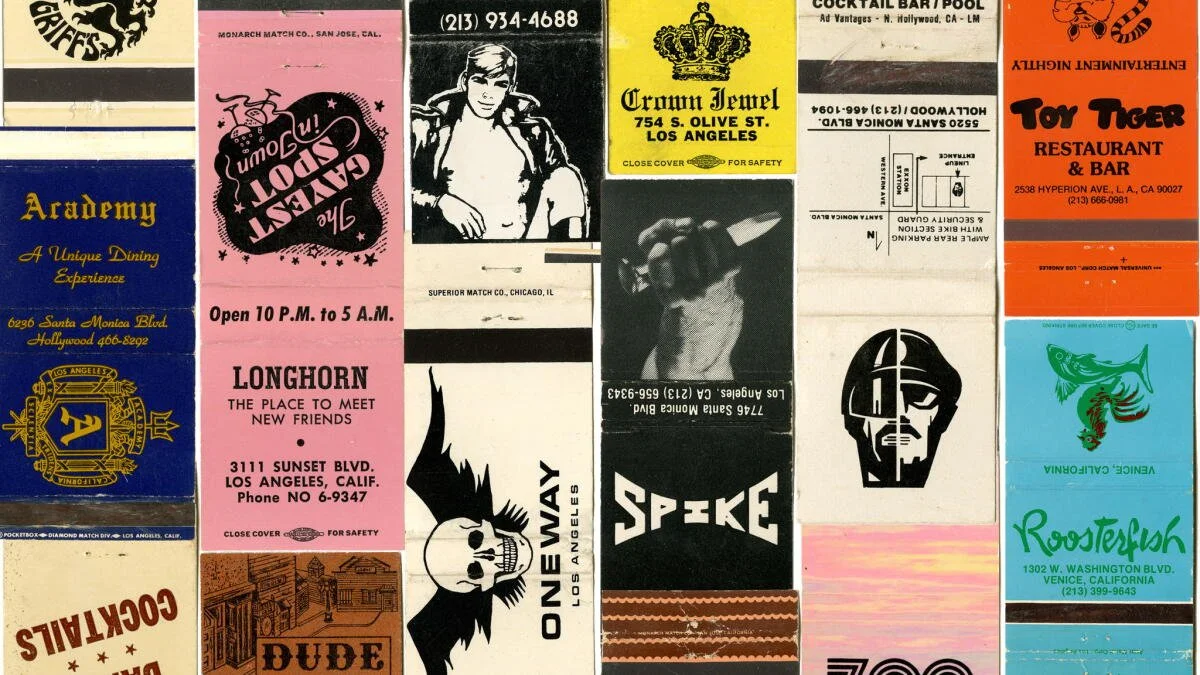
The old gay Los Angeles was not a place that was necessarily meant to be seen. In fact, much of it was deliberately hidden.
Through the 1970s and 1980s, being publicly identified as gay could cost you your job, your home or your family. Gay bars were raided. Police and newspapers sometimes photographed the people inside and published their names. There were very good reasons not to put a giant neon sign above the door announcing what happened inside.
So the bars tended to be dark, anonymous places: windowless boxes, barely marked from the street. You might know what was behind a particular door, but someone walking past might have had no idea.
And then you went inside.
That is one reason so little of this world survives in photographs. The places were dark. The people inside had reasons not to be photographed. And the generation that created much of this world was devastated by AIDS.
Young men died and left behind apartments full of the ordinary evidence of lives that had been lived: photographs, negatives, letters, diaries, clothes, records. Sometimes those things survived. Often they didn't.
It is strange to think about now, when almost every moment of a night out is photographed and uploaded somewhere. The gay Los Angeles of that era was almost the opposite. It existed in the dark, and much of it disappeared into the dark.
Photographer Reynaldo Rivera has described that Los Angeles as the last remnants of the world of John Rechy's City of Night: violent, dangerous and free. There is a certain amount of danger in freedom, he has said.
That is probably difficult to explain to people who came of age when being gay was safer, more visible and increasingly mainstream.
But the darkness was not only frightening. It could also be liberating.
Inside those bars, you could become somebody else. Or perhaps, for the first time, simply become yourself.
Silver Lake had been accumulating this world for decades. The Mattachine Society, one of America's earliest gay-rights organizations, was founded there in 1950. The Black Cat Tavern became the site of a notorious police raid in 1967 and the protest that followed, two years before Stonewall.
By the 1980s, the neighborhood had developed an extraordinary queer infrastructure. Bars sat alongside leather shops, bookstores, sex clubs and AIDS organizations. The scene was notably Latino and working class as well as white, and the neighborhood accommodated a bewildering variety of gay lives.
WeHo had the polished bars, the circuit crowd and, increasingly, the money.
Silver Lake was something else.
Leather guys had their places. Bears had theirs. There were piano bars, dance bars, neighborhood bars and sex clubs. There were punks, hustlers, artists, older men, younger men, Latino bars, kinksters and people who simply didn't fit particularly well into the more polished, stand-and-model world of West Hollywood.
In the 1990s and early 2000s, you could do a proper gay bar crawl across the neighborhood: Gauntlet II, which eventually became the Eagle; Faultline; Cuffs; Detour; Akbar; MJ's; Woody's; The Other Side; Basic Plumbing; Barracks; Meat Rack; Nighthawk; Prowl; King of Hearts; Exxile and others.
Some were bars. Some were sex clubs. Some became institutions in their own right.
You could move between them and, in a sense, between different versions of gay life without ever really leaving the neighborhood.
That was the magic of it.
Silver Lake wasn't a utopia. It could be dangerous, including gay-bashing attacks by local Latino gang members. The roughness that made the neighborhood feel exciting could also make it genuinely frightening.
But there was an energy to the place that is difficult to recreate once you have removed the danger, the secrecy and the necessity of physical proximity.
The bars didn't disappear all at once.
Detour closed in 2001. Cuffs disappeared later in the decade. The Other Side was gone by 2012. MJ's closed in 2014. Faultline eventually left its longtime Melrose location. One by one, the doors went dark.
That is perhaps the saddest part: the lights went out one bar at a time.
Silver Lake was becoming more expensive. The old houses, independent businesses, proximity to Hollywood and downtown and slightly outsider atmosphere that had once made the neighborhood relatively affordable became precisely the things that made it desirable. Rents rose. Families and wealthier professionals moved in. Restaurants and preschools replaced some of the bars and other businesses.
And gay life was changing, too.
As being gay became less socially isolating, fewer people needed a gay bar simply to meet other gay people. Then came the apps. What once required a neighborhood could now happen on a phone.
The world that had once forced people together was coming apart.
And perhaps that is why I feel so nostalgic for a place I only really encountered at the very end of its particular era.
When I made that journey to the Eagle in 2007, I had no idea I was walking into the last remnants of something. I only knew that Silver Lake felt different from anywhere I had been, and as a travel writer for a gay magazine, I had visited a lot of gay barrios around the world.
I liked the houses climbing the hills, the trees, the steep streets, the old storefronts and the feeling that the neighborhood had accumulated several different versions of Los Angeles on top of one another.
But I especially liked the feeling that something had happened there.
You could still sense it. A doorway. A bar that had changed hands. An old sign. A building that looked entirely ordinary from the outside but had once contained a whole world.
The remarkable thing about those old photographs, when you do find them, is how little they look like the gay life we know now. There are no polished Instagram shots, no branded parties, no endless images of people announcing themselves to the world.
There are men standing in darkness.
Men leaning against bars.
Men whose faces were sometimes deliberately obscured.
Men who had gone somewhere they could be themselves, but didn't necessarily want the rest of the world to know where they had been.
And perhaps that is what has been lost.
Not the bars themselves, or even the idea of a gay neighborhood, but the feeling that there was a secret world just behind the door.
A world with its own geography, its own codes, its own characters and its own nights.
A world where you could go out without documenting the evening. Where you might see the same people every night, or meet someone you would never have encountered anywhere else. Where different kinds of gay men could occupy the same few blocks and somehow create a community simply by being there.
For a few decades, Silver Lake was a place where you could live, drink, flirt, have sex, fall in love, make friends and grow old without having to leave very far.
It was messy and sometimes frightening. It was also funny, erotic, unruly and alive.
And because so much of it happened behind unmarked doors and drawn curtains, it has left remarkably little evidence of itself.
That makes the memories feel almost illicit now.
Silver Lake is still beautiful. The hills are still there. The trees are still there. The architecture is still there. The Black Cat signage remains, the Mattachine Steps are still there, and the Eagle and Akbar still draw people through their doors I believe.
But the old world is mostly gone.
Not simply because the bars closed, but because the conditions that created them disappeared.
The darkness disappeared.
The necessity disappeared.
The danger disappeared.
And, with them, some of the peculiar intimacy of that world disappeared too.
And for a little while, it was gay Neverland.