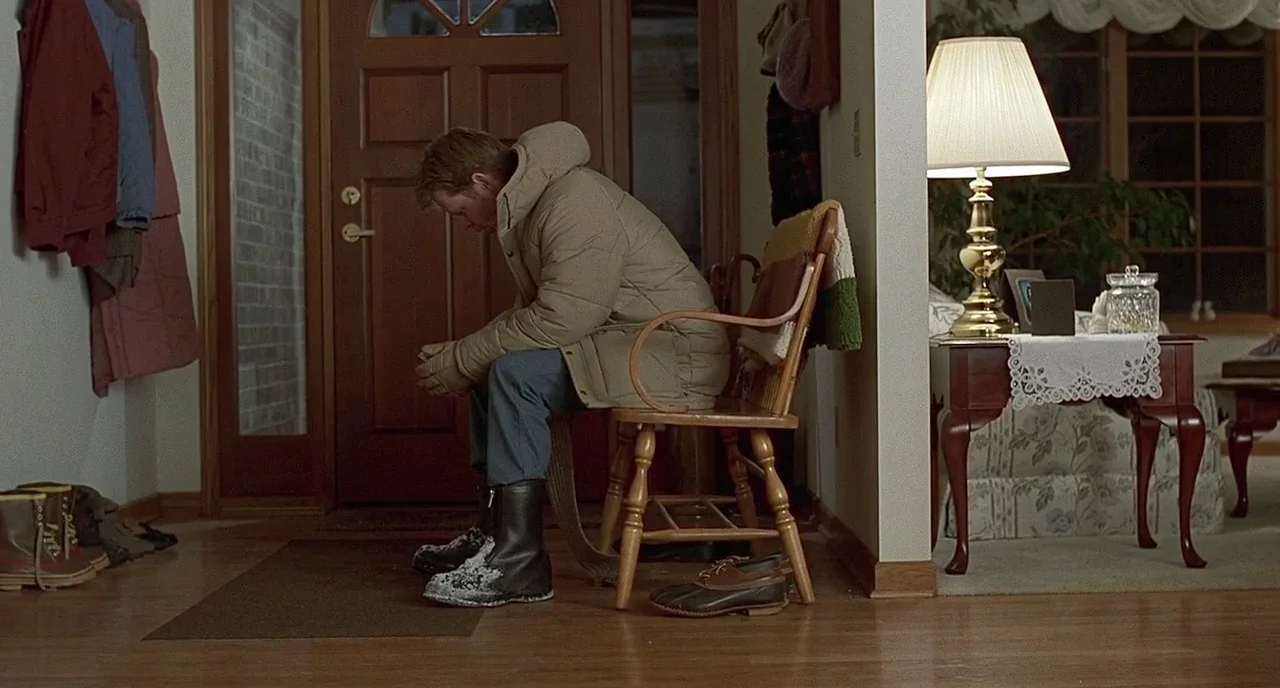
One of the things that has aged remarkably well about Fargo is the styling.
At the time, presumably, none of this was meant to look especially period. This was contemporary America. The clothes were contemporary. The cars were contemporary. The offices were contemporary. The houses were contemporary.
And yet, nearly thirty years later, it all looks incredibly specific.
That is partly because the sets are so good.
Jerry’s father-in-law’s corporate office is almost unbearably horrible. It has that particular late-1980s, early-1990s corporate ugliness that is difficult to recreate because it was never really a style. It was simply what offices looked like. Wood veneer. Beige walls. Cheap furniture. Fluorescent light. Desks and partitions that seem to have been ordered from some industrial catalogue and installed without anyone ever asking whether they looked good.
Then there is the Lundegaard house.
It is not a movie version of a suburban house. It is a house that feels mass-produced. The furniture has that slightly flimsy, factory-made quality. The colours are muted. The surfaces look synthetic. Everything seems to have been purchased because it was available, affordable and perfectly adequate.
That is what makes it so uncanny now.
The house does not look designed. It looks manufactured.
And I wonder if that was precisely the point.
The Coen brothers were making a movie about very ordinary people doing something extraordinarily stupid and terrible. So the world around them had to be ordinary too. There could be no visual glamour to distract from it. No heightened movie version of suburbia. Just offices, kitchens, bedrooms, parking lots and houses that looked exactly like the places people actually lived.
What is fascinating is that this realism has become stylization through time.
We can now look at Fargo and immediately recognize an era that the filmmakers themselves were presumably just experiencing as the present.
The cheap carpeting. The laminated furniture. The enormous coats. The geometric sweaters. The fake wood. The beige plastics. The strangely shaped lamps. The heavy telephones. The cars.
None of it was intended to say 1996.
It simply said normal.
And that is why it has aged so beautifully.
There is something almost archaeological about watching it now. You are not just watching the story. You are looking at an entire material culture that has disappeared.
Jerry’s world is commercial America. His office, his clothes, his house, even his general manner all have that slightly impersonal, mass-produced quality. And making him a car salesman is perfect because he exists inside a world of laminated surfaces, showroom gloss and things designed to be sold.
Marge’s house is almost the opposite. It feels domestic rather than commercial. Warmer, softer, more accumulated. It has the feeling of things actually belonging to someone rather than being selected from a catalogue.
That contrast could become the heart of the piece: Fargo is full of different versions of ordinary America, and the production design quietly tells you who these people are before they say very much.
The really clever thing is that neither environment screams character design. Jerry's house isn't "the house of a pathetic car salesman." Marge's isn't "the cozy house of a nice police chief." They just feel like places those people would actually live.
And that makes Jerry's world even sadder. He is surrounded by things that are supposed to signify success — the business, the house, the car dealership — but everything has the faintly depressing quality of something bought rather than loved.
The genius of the production design is that it understood something Hollywood often gets wrong: ordinary life is incredibly visually specific.
People do not furnish their houses to create a cinematic mood. They buy the sofa that is on sale. They inherit a dining table. They get the bedroom furniture from a department store. They put a television on a piece of furniture that was never specifically designed for a television. They replace something when it breaks.
The result is usually ugly.
But it is also incredibly authentic.
And Fargo understood that ugly authenticity could be beautiful on film.