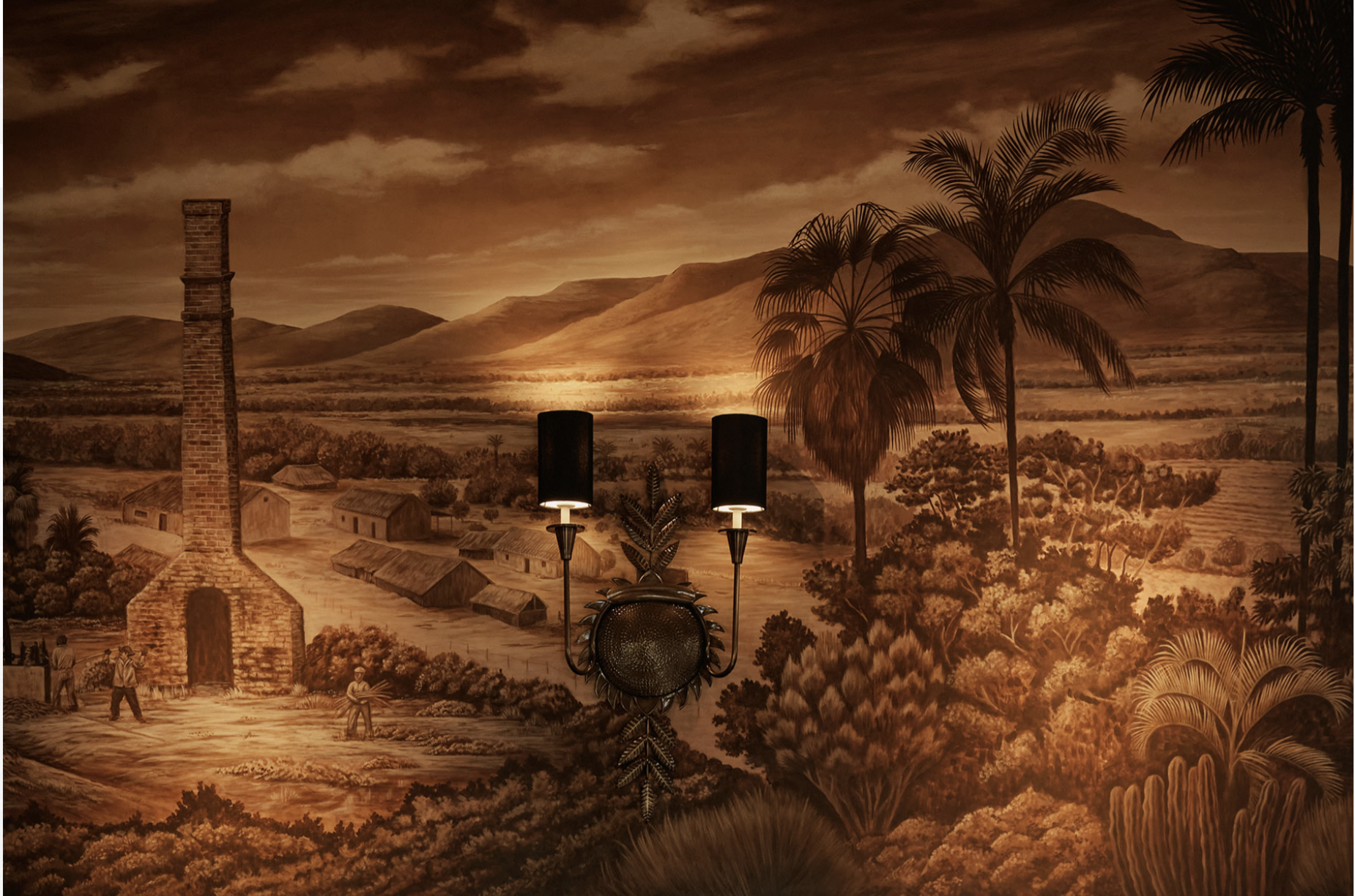
Todos Santos wasn’t built as a beach town. It began in 1733, when Jesuit missionaries founded Misión Santa Rosa de las Palmas beside rare freshwater springs in an otherwise arid peninsula. Water meant survival. The mission grew crops — especially sugarcane — and for a time in the 19th century, this small oasis became surprisingly prosperous: mills turning, mango groves flourishing, trade moving quietly through the region.
The hacienda where I’m staying — now the Todos Santos Boutique Hotel — was built for a sugar baron. High ceilings, thick masonry walls, cool tile floors. You can feel that it was built to last. In the bar, vivid murals bloom across the plaster — desert saints, palms, and wild horses running along the shoreline at Las Palmas. And if you look closely, there are bullet holes still visible in the walls — remnants believed to date back to the Mexican Revolution. History, quietly embedded in the stone.
The town itself sits a few miles inland, not for romance, but for water. The mission was built around those precious springs, which had sustained Pericú communities for generations. The Pacific beaches were working shoreline; the heart of the community was agricultural and spiritual. Today, that separation means you get both — a grounded, historic town center, and then vast, wind-brushed stretches of sand just beyond.
Here, the beaches are wild in a way that commands respect — surf that crashes, currents that pull, and horizons stretching to infinity. This is not the turquoise, float-all-day water of Cancun; this is water that roars, asserting its power with every wave. Occasionally, plumes from gentle giants rise along the horizon — migrating whales tracing ancient routes — while turtles, guided by the moon, return to nest on the same sands their ancestors knew.
There is something quietly profound, too, about its position along the Tropic of Cancer — an invisible astronomical boundary between temperate and tropical. A celestial line befitting a primordial place where the Sonoran Desert meets the ocean.
Early Spanish cartographers depicted the Baja peninsula as an island — an understandable mistake. Today, it still feels otherworldly. Here, it’s just pelicans, salt air, and peace — a land shaped by time and tide.