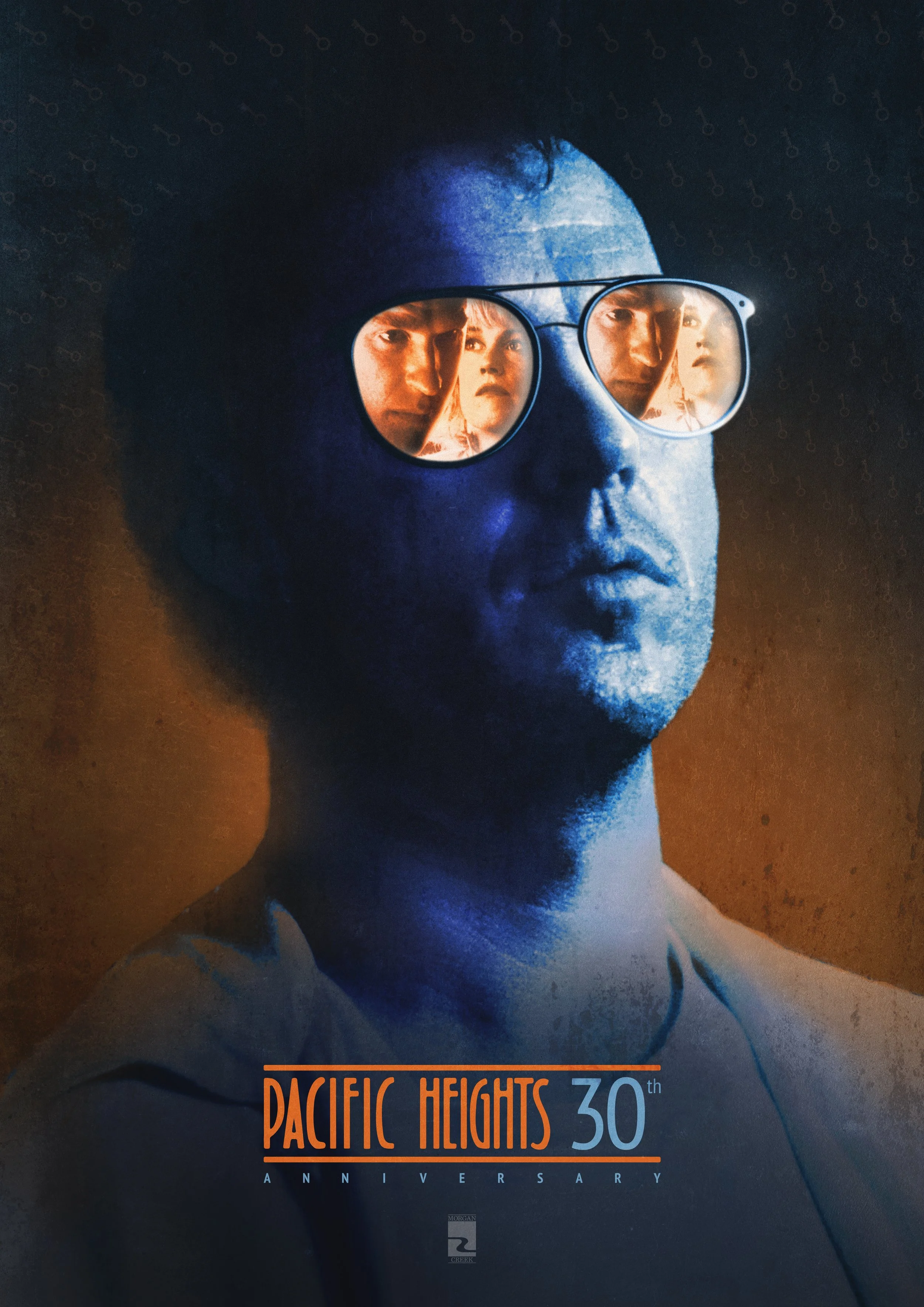
By the time the Berlin Wall had fallen and the Soviet Union dissolved, the grand geopolitical monsters of the 20th century had receded. What replaced them was something more intimate, more insidious: the enemy who signs a lease and moves in downstairs. The 1990s, for all their technological optimism, grunge cool, and economic rebound, were an extremely paranoid decade in the U.S. The fears that once pointed outward—at nuclear annihilation or foreign ideology—now curled inward, toward the home, the neighbor, the roommate, the tenant. Nowhere is this shift captured more chillingly than in Pacific Heights (1990), a film that weaponizes normalcy itself into a form of bureaucratic horror.
In Pacific Heights, directed by John Schlesinger, aspiring yuppies Drake and Patty (Matthew Modine and Melanie Griffith) purchase a Victorian fixer-upper in San Francisco. Like many in the late-’80s boom, they overextend, banking on rental income from the downstairs unit to service their mortgage. Enter Carter Hayes (Michael Keaton), a soft-spoken drifter who understands the city’s tenant protections better than most landlords ever will. He pays no rent. He damages the property. He provokes just enough to trigger responses that can be documented as harassment. The system—designed to shield vulnerable renters from predatory property owners—becomes the instrument of their slow-motion ruin.
There is no masked killer here, no supernatural force, no cathartic shootout. The horror is procedural: police officers who recite rules rather than intervene, courts clogged with delays, utility shutoffs reframed as illegal retaliation. You cannot fight back without becoming the villain on paper. Change the locks? Illegal. Document the destruction? It becomes evidence against you. The film’s dread lies in the correctness of the nightmare. The processes meant to prevent abuse have become the abuser.
This is what makes Pacific Heights feel more frightening than its contemporaries. Compare it to Single White Female (1992), where the terror is personal and psychological—an obsessive roommate who literally tries on your identity—or Unlawful Entry (1992), in which Ray Liotta plays a seemingly heroic cop who responds to a home invasion at the upscale Los Angeles home of Kurt Russell and Madeleine Stowe’s characters, only to begin a campaign of relentless harassment.
Those films still offer a clear antagonist to confront. Pacific Heights offers something colder and more systemic: a villain who mostly just exists and litigates. Violence is secondary to financial erosion, reputational damage, and helplessness. It is closer in spirit to Kafka’s The Trial or Terry Gilliam’s Brazil than to any slasher. The true antagonist is not one man, but the institutional inertia that protects him.
The Post-Cold War Inward Turn
The clustering of these domestic thrillers in the early 1990s was no accident. With the Cold War’s end came a cultural pivot. For decades, American cinema had externalized threats: Soviets, terrorists, invading armies. Now the danger lived inside the walls. Home, once the ultimate symbol of stability and the American Dream, became a site of fragility—especially in expensive coastal cities where housing pressures were intensifying.
San Francisco in Pacific Heights is not incidental. The city had become shorthand for landlord-tenant warfare, with tenant protections strengthened by earlier progressive movements. Rising costs, yuppie gentrification, and urban density turned “your castle” into a leveraged liability. Privacy was no longer guaranteed; it was negotiated through leases and shared spaces. The film captures a precise anxiety of the era: ownership feels illusory when the person living under your roof understands the rules better than you do. Asymmetric information flips the expected power dynamic. The tenant becomes the parasite, and the house—the biggest investment most families will ever make—eats its owners alive through perfectly legal channels.
This wasn’t mere cinematic exaggeration. Real-world stories of nightmare tenants circulated widely, just as tales of abusive landlords had fueled the very protections now being gamed. The era’s economic anxieties—personal finance, property values, relationship instability—found expression in films that refused the safety of genre abstraction. Everything felt plausible, bureaucratically grounded, socially adjacent.
Other movies amplified the theme. In The Hand That Rocks the Cradle (1992), a trusted nanny invades the family sanctuary. Sleeping with the Enemy (1991) shows domestic abuse hiding in plain sight for Julia Roberts, who has to learn how to swim and pretend to be dead to escape her abuser. Falling Down (1993) dramatizes an ordinary man snapping against the bureaucratic grind of modern life. Across these works, the message was consistent: the danger isn't always the outsider—sometimes it's the person sharing your bed and bank account.
Civilization is thinner than it looks. It's a fragile agreement held together by people mostly choosing to "play ball"—following norms, keeping their resentments in check, honoring trust in everyday roles (nanny, spouse, neighbor, stranger on the road). Once someone defects, the whole setup frays fast. These aren't slasher movies with supernatural evil. They're about proximity and defection. The threat is usually right next to you, wearing a normal face, until the mask slips. Safety isn't guaranteed by institutions or laws alone—it's heavily dependent on most people self-regulating.
Systems Designed to Protect
At the heart of this 1990s anxiety is a deeper idea: systems designed to prevent abuse can themselves become the abuser. Tenant protections, intended to shield the vulnerable, create new exploitation vectors. Custody laws that historically favored mothers—rooted in the “tender years” doctrine—produced unfair outcomes for fathers, turning family courts into arenas of rampant institutional bias. These are not symmetrical phenomena, and both have trade-offs. Pre-1970s landlord power carried its own abuses. Yet the 1990s films dramatize the moment when good intentions overshoot or get gamed, when protective bureaucracies harden into traps.
This is bureaucratic violence in its purest form: harm delivered not through dramatic confrontation but through impersonal rules, paperwork, and institutional thinness. It echoes Hannah Arendt’s “banality of evil”—the quiet destructiveness of ordinary functionaries and procedures—updated for the administrative state. Or, in Foucauldian terms, disciplinary power operating through normalized systems rather than overt authority. The police don’t refuse to help out of malice; they simply follow protocol. The courts aren’t corrupt; they’re slow and one-sided in practice.
The decade’s paranoia was not unfounded, even if it coexisted with genuine cultural vitality. It reflected a growing distrust in institutions—not full-blown conspiracy, but a recognition of their blind spots and perverse incentives. External threats had faded, but domestic and relational fragility filled the vacuum.
Why It Feels Even Truer Today
These films have aged into something prophetic. What was marketed as “psychological thriller” in the 1990s now reads like sustained horror: the procedural traps laid then have only grown more sophisticated with technology and regulation. Pacific Heights remains the purest distillation because it offers the least escape. There is no heroic confrontation, no simple villain to defeat. The threat signs the lease, pays nothing, and weaponizes the very safeguards meant to promote fairness. In doing so, it captures the particular dread of late modernity: being trapped inside correct processes that still produce nightmare outcomes.
The real monster of the 1990s—and perhaps our own time—was never a foreign power or a supernatural force. It was the quiet realization that the systems we built to protect us could, under the right circumstances, turn the home itself into a cage. And the person holding the key might just be the one living downstairs.