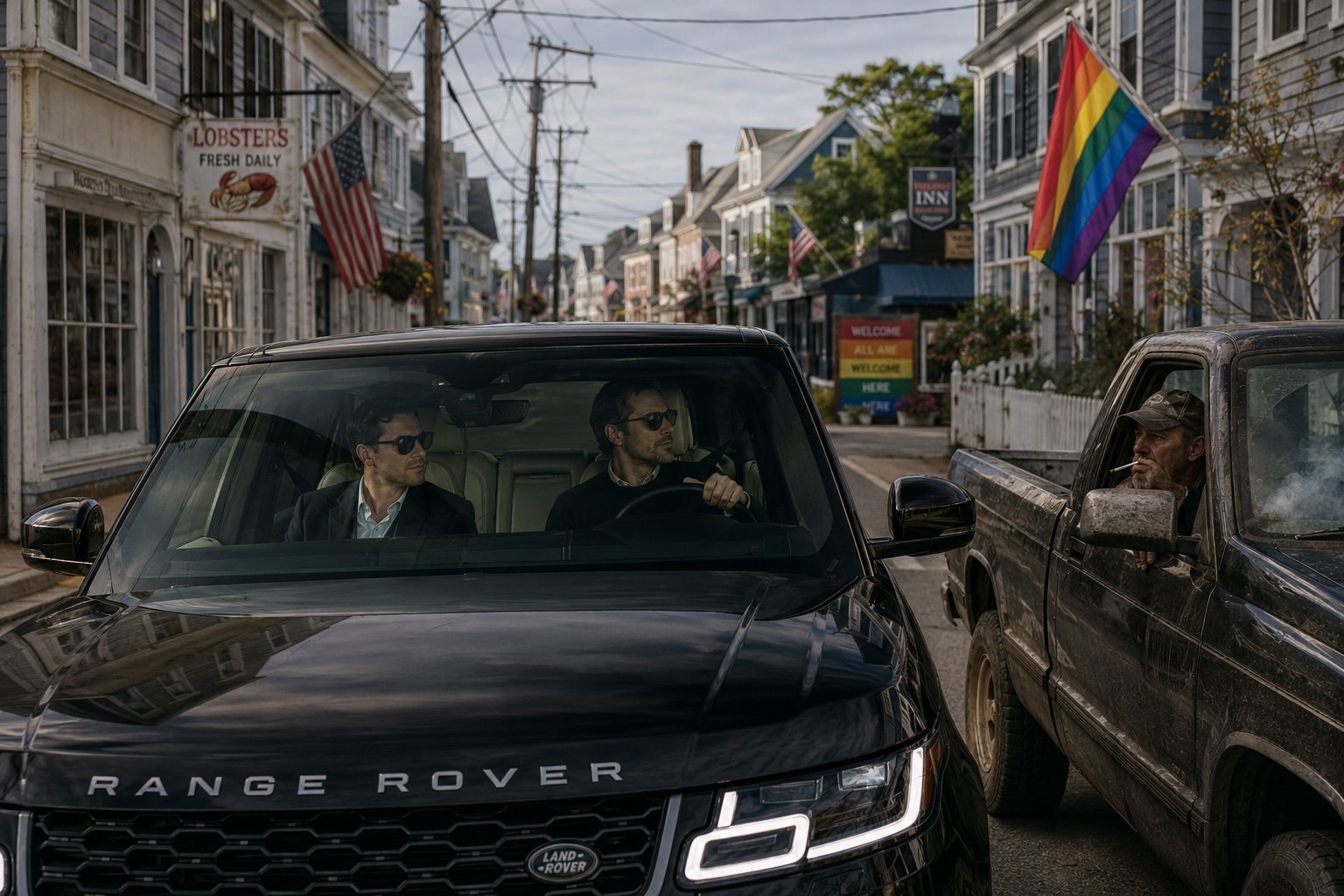
A Range Rover glides through the potholed streets of a small New England town. Faded storefronts, weathered houses, and aging signs pass in reflection across its polished surface — two Americas briefly superimposed, neither fully acknowledging the other.
At a traffic light, a pickup truck rolls to a stop alongside. The driver sits with the window cracked open, smoking, a gray curl of tobacco rising into the summer air. He glances toward the couple in the Range Rover — well-dressed, contained, slightly out of place in a town that feels economically paused rather than abandoned.
Inside the climate-controlled cabin, a brief exchange passes between the two men. Nothing of consequence is said, yet something is understood: not hostility exactly, but distance. Strangers sharing the same land, occupying the same landscape but arriving from entirely different worlds.
As working towns give way to coastal villages, the architecture of affluence becomes more visible — restored facades, carefully curated main streets, and public spaces shaped as much by tourism as by local life. In many of these places, one symbol recurs with particular clarity: the rainbow flag.
It has become difficult to view that symbol outside its institutional context. It flies from municipal buildings, adorns crosswalks and seasonal banners, and appears in corporate logos. What began as a discreet signal — a way of indicating safety in environments where safety could not be assumed — has become a ubiquitous marker of civic identity.
The original Pride flag was functional as much as expressive: a quiet code that a space was safe, or at least safer. In places like Provincetown or Ogunquit, it once worked almost like a semaphore — a quick way of reading a town, of knowing where one might move without fear or explanation. At the time, that signal carried real weight. Gay life was often hidden, policed, or socially precarious. The flag did not represent consensus; it marked exception.
Over time, however, the symbol migrated. From bars and private storefronts, it moved into municipal identity, then corporate branding, and eventually into the visual grammar of entire regions. What was once a message of access became, in many places, an expectation of alignment.
As a former travel journalist working during the rise of the “pink pound” in the UK, I spent years on press trips where hotel chains and tourism boards were still learning how to market to affluent gay travelers. In the late 1990s and early 2000s, even modest gestures of inclusion were considered commercially risky. Looking back, that period marked an early phase in the normalization of LGBTQ identity within mainstream consumer culture, where visibility and market expansion advanced together.
The question is not whether inclusion is desirable. The harder question is what happens when symbols of dissent are absorbed into the aesthetic and economic systems they once stood apart from.
Driving through these communities today, a visitor encounters a layered visual language: rainbow-painted intersections, curated storefront displays, institutional proclamations of inclusivity. The effect is not simply welcoming — it is declarative. It suggests not only that one is welcome, but that meaning has already been assigned.
Meanwhile, in towns not far away, different pressures dominate: housing affordability, seasonal employment, and the fragility of economies built on tourism cycles. These realities coexist geographically but rarely intersect culturally.
This pattern is not unique to LGBTQ identity. Contemporary America increasingly expresses politics and values through visible signage — flags, slogans, yard signs, corporate statements — that function less as persuasion than as confirmation for those who already agree.
The irony is that some of the regions most associated with openness have also become among the least accessible. Over time, the symbolism of inclusion has become entwined with affluence — not by design, but because visibility tends to follow resources.
None of this negates the real history that produced the Pride movement. The violence, legal discrimination, and social exclusion were genuine and, in many cases, not distant. But symbols do not remain frozen in their original context. They accumulate new meanings as they pass through institutions, markets, and time.
If the Pride flag once served as a protective emblem for an oppressed minority, what does it signify when that group is no longer broadly oppressed? If we truly believe everyone should live free from discrimination and have equal opportunity to thrive, should that principle not also extend to the man in the pickup truck? What does inclusion mean in a society where different forms of precarity sit side by side, often without touching?