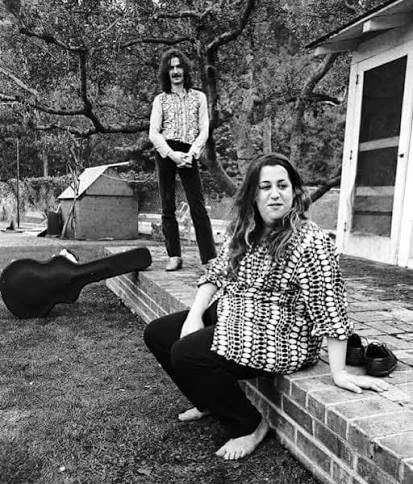
There is a particular moment when driving up into Laurel Canyon when Los Angeles seems to disappear.
The traffic noise fades first. The boulevards give way to serpentine roads, dense foliage, and houses hidden from one another behind steep hillsides. Sunlight filters through eucalyptus and live oaks onto homes that seem less built upon the landscape than placed there by it—as though the canyon itself had decided where they should stand.
The city’s commercial excess falls away, revealing another Los Angeles: one where the polished mythology of Hollywood gives way to something older, more elusive, and far less easily explained.
It is easy to understand why generations of artists came here seeking reinvention. Laurel Canyon offered something increasingly difficult to find in post-war America: the illusion of escape. A musician could live among the trees, write songs in a hillside cottage, and believe, at least temporarily, that the rules governing the rest of society no longer applied.
The canyon became a place where young people could experiment with identity, art, spirituality, and possibility. It was not simply a neighbourhood; it was an idea.
By the late 1960s, that idea had become one of the most powerful myths in American culture. The hills above Hollywood became home to an extraordinary concentration of musicians who would define an era: The Doors, The Byrds, Love, The Monkees, Frank Zappa, The Mamas & the Papas, Mama Cass Elliot, and many others who passed through this small, winding network of roads.
Houses became informal salons where musicians gathered, friendships formed, and songs that would shape a generation were written among the trees.
The image remains intoxicating: musicians on porches, guitars leaning against walls, conversations stretching late into the evening—a community searching for something beyond conventional American life.
Laurel Canyon seemed to embody the promise of California itself: that with enough imagination, courage, and sunshine, a person could invent an entirely new self.
But places, like people, rarely reveal everything at once.
The same hills that nurtured creativity also concealed loneliness, addiction, exploitation, and tragedy. Houses disappeared behind dense vegetation. Roads twisted unexpectedly. Neighbours could live only a few hundred feet apart yet remain almost entirely separate.
It was a landscape that encouraged both intimacy and isolation.
Perhaps the most intriguing contradiction of Laurel Canyon lay in who many of its revolutionaries actually were.
The counterculture is often remembered as a rebellion against the American establishment, yet many of its most influential voices emerged from the very institutions that defined post-war America: military families, government circles, universities, and professional households shaped by the Cold War.
Jim Morrison was the son of Navy Admiral George Stephen Morrison, whose career placed him close to some of the defining military events of the Vietnam era. Frank Zappa grew up in a household shaped by his father's work in chemical warfare research at Edgewood Arsenal.
Others came from similarly structured worlds: educated families, disciplined homes, and communities built around achievement, science, and national service.
The irony was profound.
The same post-war system that created military power, technological advancement, and economic security also created a generation with enough freedom to question the values of that system.
The rebellion was not simply an escape from America. In many ways, it was one of America's unexpected products.
That paradox becomes even more fascinating when considering the role of psychedelics.
The CIA’s MKUltra program, which operated from 1953 into the 1970s, explored techniques of psychological influence and interrogation, including experiments involving LSD. Some of these experiments involved unethical practices, including administering substances to people without informed consent.
At the same time, LSD was moving through scientific, artistic, and intellectual circles far beyond government research. Figures such as Ken Kesey and Robert Hunter encountered psychedelics through government-linked research environments and later became influential figures in the psychedelic movement.
The irony was unmistakable: a government program designed to understand and potentially control altered states of consciousness existed alongside a cultural movement that embraced those same experiences as a pathway toward creativity, freedom, and expanded awareness.
Laurel Canyon was not the centre of the psychedelic movement in the way San Francisco’s Haight-Ashbury district was, but it absorbed the same atmosphere. Psychedelic ideas flowed through its music, conversations, and artistic experimentation.
A program intended to explore control became part of a much larger cultural moment defined by questioning authority.
Adding another layer of mystery was the presence of Lookout Mountain Air Force Station, the secretive Cold War-era military film facility hidden among the hills. There, Hollywood technicians worked behind high security to produce classified footage of nuclear tests and other military projects.
The contrast was extraordinary: a hidden government facility operating within the same landscape that became a sanctuary for artists, musicians, and countercultural experimentation.
Naturally, such a setting invited speculation. Writers such as Dave McGowan, in Weird Scenes Inside the Canyon, argued that the Laurel Canyon scene may have contained deeper connections between military backgrounds, intelligence networks, and cultural movements.
Most historians, however, view Laurel Canyon as the result of a far broader and less coordinated convergence: Los Angeles’ entertainment industry, post-war migration, military expansion, economic prosperity, and a generation searching for new forms of expression.
The mystery endures not because everything was orchestrated, but because so many unlikely worlds existed in such close proximity.
Laurel Canyon was where Hollywood met the military-industrial age, where suburban privilege met rebellion, where technological power met spiritual exploration.
It is easy to forget that post-war Los Angeles was not only the world’s entertainment capital but also one of America’s great military and aerospace centres. The Cold War transformed Southern California into a landscape of bases, research facilities, aircraft manufacturers, and defense contractors.
For many of their children, childhood meant constant relocation, disciplined households, and the geopolitical anxieties of the age.
Reinvention did not simply become attractive—it became imaginable.
The irony is that rebellion requires resources. A society must be stable enough, wealthy enough, and open enough to produce people who can afford to challenge it.
The machine built the environment. The children decided to question the machine.
And the children of the military-industrial age became the poets, mystics, and iconoclasts of the psychedelic generation.
Today, the trees still arch over narrow roads. The houses remain hidden among the hillsides. The afternoon light still creates the same golden haze.
A visitor could easily believe that nothing has changed.
Yet every hillside has its previous occupants. Every house has its stories. Every road carries traces of the people who passed through it: musicians chasing immortality, actors seeking privacy, dreamers searching for meaning, and those who discovered something far darker than they expected.
Laurel Canyon endures because it contains so many of California’s contradictions within one steep, wooded bowl: utopian dreaming and Hollywood cynicism, artistic freedom and industry machinery, natural beauty and hidden power, openness and secrecy.
It remains a place where paradise seems entirely possible—accompanied always by the uneasy suspicion that paradise was never quite as innocent as it appeared.