Long before Topanga became a bohemian enclave, a movie location or a weekend escape from Los Angeles, it was part of an Indigenous world that had existed here for thousands of years. Some of the most remarkable evidence of that world was discovered at Topanga Beach in 1910, when a group of Stanford students came upon an ancient Native American burial site in the bluffs near the mouth of the canyon.
The burial mound at Topanga Beach
In July 1910, newspapers reported that geology students from Stanford University had excavated a large number of Native American burials near the mouths of Topanga and Temescal Canyons. The Los Angeles City Planning Department's historical account records 34 bodies discovered in the bluffs of Topanga.
It is an extraordinary number to encounter in the history of a place that now looks so thoroughly modern. There was no Pacific Coast Highway then, no steady stream of cars passing through the canyon and no development crowding the slopes. There was simply the canyon, the creek, the beach and the remnants of a much older human landscape.
And the story did not end with the excavation. In 1923, construction of the road at the mouth of Topanga Canyon reportedly cut through another prehistoric burial area. Archaeologists later noted that the exact archaeological site involved is uncertain. The road, of course, eventually became part of the Pacific Coast Highway.
A landscape that had been used by Indigenous people for generations was transformed into one of Southern California's busiest automobile corridors. The burial ground disappeared beneath the modern landscape.
Who were the people buried here?
The people who lived in the Topanga area were part of the Indigenous communities now generally identified as Tongva, whose ancestral territory encompassed much of the Los Angeles Basin and surrounding region. The name Topanga itself derives from the Tongva place name Topaa'nga, although its original meaning has been lost.
The canyon offered an extraordinary combination of resources: fresh water from Topanga Creek, access to the coast, oak woodland, native plants and animals, and routes connecting the interior mountains with the ocean. Archaeological evidence tells us that people had been living in the Topanga region for thousands of years.
That makes the discovery of those 34 burials even more intriguing. It is tempting to imagine a single cemetery: a defined patch of ground containing 34 graves. But that may not be what we are looking at. The archaeological record from Topanga represents a much longer and more complicated history, with ancient habitation deposits, tools, milling equipment and human burials discovered at multiple sites.
At the Tank site, for example, archaeologists documented 19 primary and secondary burials in a site dating to the Millingstone period. The 34 people discovered in 1910 therefore should not necessarily be thought of as the people buried in Topanga. They are simply the people whose remains happened to be exposed and recorded during one episode of archaeological excavation.
How many others were buried in the broader Topanga landscape over the centuries? We don't know. And perhaps we never will.
The landscape is the remnant
There is something slightly misleading about asking what "remains" of the Tongva world survive in Topanga. It suggests that we should be looking for an artifact: a wall, a monument or a ruined structure.
But Topanga did not need to be built in order to be inhabited.
The creek was already here. The canyon was already here. The oak woodland was already here. The rocky slopes and terraces were already here. The coastline was already here. These were the things people knew and moved through, the physical landmarks around which their lives unfolded.
And some tangible traces of that use of the landscape do remain. Archaeological sites in the Topanga area have produced stone tools, milling equipment and other evidence of daily life. Indigenous people also used bedrock mortars for processing plant foods, and some of these features have survived in the Santa Monica Mountains.
The buildings and roads are the new layer. The landscape underneath them is much older.
Imagine Topanga 1,000 years ago
If you could stand in Topanga a thousand years ago, you would not be standing in an untouched wilderness. You would be standing in a lived-in landscape.
People would have been moving through the canyon, following the creek, gathering food, processing plants, fishing and traveling between settlements. There would have been familiar places known by name, and stories attached to particular rocks, springs, mountains and stretches of coastline. Children would have grown up knowing the canyon not as scenery, but as home.
And there would have been people dying here, too.
Their communities had ways of caring for and remembering their dead. Some were buried; cremation was also practiced among Indigenous communities of the region. Over generations, the dead became part of the same landscape in which the living had made their homes.
That is perhaps the most difficult thing to picture when looking at Topanga today. The landscape was not merely inhabited by people who happened to live here. It was a place of birth, life, death and memory.
Then came the bulldozers
The 1910 discovery was made by people who were essentially visitors to that landscape: Stanford students and their instructor, excavating Native remains as archaeological specimens. A little more than a decade later, the highway came through.
The 1923 road construction at the mouth of Topanga Canyon cut through another prehistoric burial area. What had once been a place of Indigenous life and burial became a transportation corridor carrying modern travelers along the Southern California coast.
And yet the old landscape never completely disappeared.
It is still there beneath the roads and houses, in the shape of the canyon and the course of the creek, in the oak trees and rocky slopes that have outlasted generations of human development.
A strange world beneath modern Topanga
What makes local historian Pablo Capra and archaeologist Chester King's research particularly fascinating is that the story of Topanga's Native inhabitants is not simply an archaeological inventory of tools and bones. It opens onto an entire lost world.
Their research into the Topanga Beach burial mound brings together accounts of men with horns, dwarfs, giants, Aztec invasions and smoking mountains, alongside the much more mundane but equally strange history of the people who rediscovered the site: a class of Stanford students, an artifact collector from Wisconsin, a Civil War colonel and even a family of squirrels.
It sounds almost like folklore. In fact, it reads like the ingredients for an old Topanga tall tale.
But beneath the strange stories is something very real: evidence that the landscape around us has a history that stretches vastly further back than the modern town.
The Topanga Historical Society's presentation of Capra and King describes the 1910 burial mound as a forgotten Native American site that was ultimately paved over by the construction of Pacific Coast Highway in 1923.
What happened to the people buried there?
We don't have a satisfying ending to that question.
The remains discovered in 1910 did not become a preserved monument. Burial areas were disturbed, archaeological deposits were damaged or destroyed, and some sites were looted by artifact hunters. The precise location of some of the early discoveries is now uncertain, and there may be other burials in the Topanga landscape that were never discovered at all.
But the deeper story begins long before the bulldozers arrived.
By the time those Stanford students opened the burial site in 1910, the Indigenous world they were uncovering had already been profoundly disrupted. The people whose ancestors lay in those bluffs had lived in the region for thousands of years, but centuries of Spanish colonization, missionization, disease and displacement had transformed the communities and landscapes in which their ancestors had lived.
The bulldozers, in other words, did not erase the Tongva. They erased pieces of the physical landscape in which the Tongva had lived.
There is something strange about driving through Topanga today and thinking about the people who were buried here. It isn’t that there is a mysterious "Indian burial ground" hidden somewhere, waiting to be discovered. It is that Topanga itself was the burial landscape: the steep slopes and rocky terraces, the creek winding through the canyon, the oak trees, the beach and the mountains rising above it all.
These were not simply scenic features surrounding a village. They were the places through which generations of people moved, lived, gathered food, raised children and buried their dead.
The houses came later. The highway came later. The traffic came later.
The landscape was here first.
And somewhere beneath the modern layers of Topanga Beach, there may still be pieces of that much older world — places where the boundary between archaeology and the living landscape is no longer visible.
You simply have to know that you are looking at it.
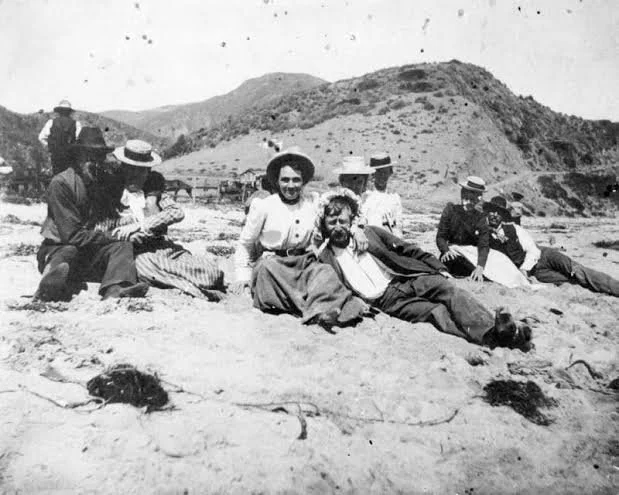
In this picture, Topanga pioneers celebrate the opening of the canyon road in 1898.