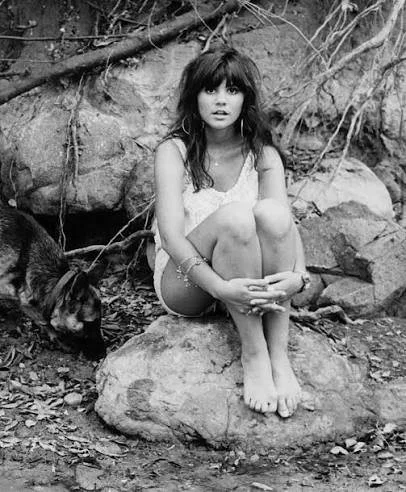
As the Laurel Canyon dream began to lose some of its innocence, many artists looked westward toward the deeper folds of the Santa Monica Mountains. If Laurel Canyon had become the stage on which the counterculture announced itself, Topanga offered something more private: a place to disappear, to experiment, and perhaps to believe that a different way of living was still possible.
Among those drawn to its winding roads was Linda Ronstadt, the young singer who became known as the “barefoot lady of Topanga.” The image captured something essential about the canyon in that era: the sense of freedom, informality, and possibility that attracted a generation of musicians searching for a life beyond the expectations of the mainstream. Yet beneath that romantic image existed a more complicated reality.
Topanga was never simply a sanctuary. Its isolation gave people space to create, but it also allowed problems to remain hidden. The same hills that sheltered musicians, writers, and dreamers also sheltered excess, addiction, and people living at the edges of society. The canyon’s openness—its refusal to ask too many questions, its tolerance for outsiders—was part of its appeal, but it was also part of its danger.
The tragedy of Topanga was that the qualities that made it magical were the same qualities that made it vulnerable. Its remoteness offered freedom, but also separation. Its rejection of convention encouraged creativity, but sometimes removed the structures that protected people from their own excesses.
The canyon became a place where the California dream could be lived intensely and briefly: beautiful, unconventional, and liberating, but never entirely safe.
Others who lived here include Roger McGuinn and Chris Hillman of The Byrds, Taj Mahal, Tim Buckley, members of Spirit and Canned Heat, and later Neil Young, who recorded portions of After the Gold Rush in a basement studio here.
At the center of this world was the Topanga Corral, a former country-western roadhouse transformed into a gathering place for the counterculture. Under its wooden roof, blues musicians, bikers, folk singers, and canyon residents shared the same small stage. It was an unlikely meeting point between old California and the new one emerging in the 1960s.
The image remains powerful: long nights at the Corral, guitars competing with the sound of the creek, musicians gathered around fires, artists testing the boundaries of what life could become. Topanga represented another version of the California dream—not Hollywood glamour, but a return to something more elemental. A belief that a person could step outside the machinery of modern life and create something more authentic.
But places, like people, rarely reveal everything at once. The same rugged terrain that nurtured solitude also created vulnerability. Steep slopes, narrow roads, fire-scarred ridges, and unpredictable creeks made the canyon both beautiful and unforgiving. Houses could feel completely isolated even when neighbors were nearby. The same independence that attracted artists could also allow darker elements to remain hidden.
Topanga’s reputation as a refuge for outsiders meant that it attracted not only musicians and artists, but also people living further beyond society’s margins. The canyon’s countercultural openness existed alongside drug culture, violence, and tragedy. Charles Manson and his followers moved through the broader Topanga orbit, and musician Gary Hinman, who lived in the area, became one of their early victims. In 1970, Canned Heat guitarist Alan “Blind Owl” Wilson died in the canyon, another reminder of the era’s fragile boundary between creativity and self-destruction.
Topanga promised authenticity: a life closer to nature, removed from the pressures of the modern world. Yet the canyon remained connected to the same cultural forces it was trying to escape. Musicians still depended on the industry below. Fame still followed people into the hills. The outside world was never truly gone.
Perhaps that is Topanga’s greatest contradiction. It has always been portrayed as gentler and more bohemian than its neighbor Laurel Canyon, yet it carried a wilder edge: horses and motorcycles, folk songs and roadhouse blues, spiritual seekers alongside old-timers and outsiders. It was never as neatly packaged as the Laurel Canyon legend, and perhaps that allowed it to retain something more authentic.
The canyon has endured its own hauntings: the memory of fires that reshaped hillsides, floods that erased homes, and generations of artists who arrived searching for freedom and sometimes found something more complicated.
Today, Topanga remains fiercely itself. The roads still wind through dense foliage. After rain, the air still carries the scent of sage and eucalyptus. Artists, musicians, and new generations of seekers continue to arrive, drawn by the same promise that has shaped the canyon for decades.
The Topanga Corral is gone, but its spirit survives in places such as the Will Geer Theatricum Botanicum, in galleries tucked among the hills, and in the stubborn refusal of residents to surrender entirely to the pace and pressures of Los Angeles.
Topanga endures not as the louder legend, but as something quieter and more resilient. It represents one of California’s oldest contradictions: the desire to leave society behind while remaining connected to its stories, its music, and its dreams.
The hills are beautiful. The creeks still run. But the land remembers every fire, every flood, and every song once sung beneath its oaks.