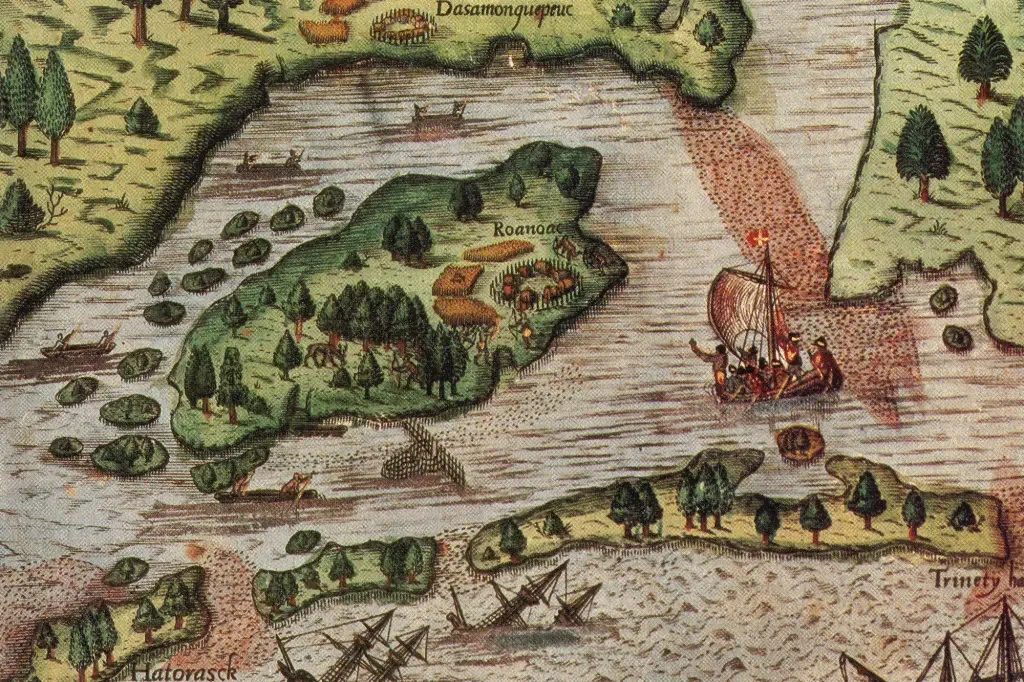
The disappearance of the Roanoke colonists was probably not an inexplicable vanishing but the likely outcome of a struggling English settlement attempting to survive in a harsh and unfamiliar environment. Established in 1587 under the sponsorship of Sir Walter Raleigh, Roanoke represented one of England's earliest efforts to establish a permanent foothold in North America. Like many colonial ventures of the era, it faced daunting challenges, including unreliable supply lines, food shortages, disease, and complex relationships with the Algonquian-speaking peoples who already inhabited the region.
When Governor John White returned in 1590 after a resupply voyage delayed by the war with Spain, he found the settlement deserted. Rather than evidence of violence, he encountered signs of an orderly departure. Buildings had been carefully dismantled rather than destroyed, and the only messages left behind were the word "CROATOAN" carved into a palisade post and the letters "CRO" etched into a nearby tree. Before White had departed three years earlier, the colonists had agreed that any planned relocation would be marked in this way. "Croatoan" referred to present-day Hatteras Island, home to a Native community that had maintained relatively friendly relations with the English.
Although later generations transformed Roanoke into the legend of the "Lost Colony," the evidence has long pointed toward a far less mysterious explanation. Archaeological excavations on Hatteras Island have uncovered English metal tools, weapons, ceramics, and other artifacts dating to the late sixteenth century in contexts that suggest prolonged interaction—and possibly the gradual absorption of at least some colonists into the Croatoan community. Other discoveries inland have raised the possibility that portions of the colony relocated elsewhere as well, indicating that the settlers may have dispersed rather than remained together.
As England established more successful colonies, particularly at Jamestown in 1607, the fate of Roanoke faded into the background of history. In recent decades, however, archaeological discoveries and renewed scholarship have shifted the focus away from sensational theories and toward the practical realities of survival. Rather than a supernatural disappearance, Roanoke increasingly appears to have been a story of adaptation, migration, and the difficult choices faced by a vulnerable community cut off from its homeland.
Today, the surviving archaeological sites and artifacts provide a tangible connection to this pivotal moment in early colonial history. They offer a glimpse into a world where English expansion was still uncertain, alliances with Native peoples could mean the difference between life and death, and survival often depended on abandoning expectations in favor of necessity. The enduring fascination with Roanoke lies not in an unsolved mystery, but in what it reveals about the precarious beginnings of England's American colonies.